
AI-Generated Images of Jesus Christ from the Shroud of Turin Ignite Old Debate | Read Here
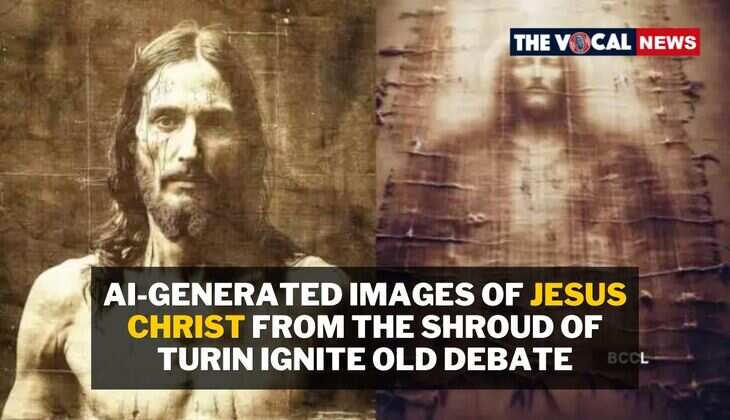
Artificial intelligence (AI) has once again stirred up a long-standing debate, this time by generating images of Jesus Christ based on the Shroud of Turin. These AI-created depictions, which have gone viral across social media platforms, are reigniting discussions about the authenticity of the Shroud and its connection to Jesus Christ.
The Viral AI Images
Several AI-generated images of Jesus Christ have surfaced online, each offering a different interpretation of the figure based on the Shroud of Turin. One particularly popular image, created using the AI platform Midjourney, resembles traditional depictions of Jesus with shoulder-length hair and a beard. This image has garnered significant attention for its striking similarity to classical portrayals seen in religious art throughout history.
Another image, shared by the Daily Express, presents a bare-chested man with visible wounds, suggesting recent torture and death. This image seems to evoke the narrative of the crucifixion, with the wounds serving as a stark reminder of the suffering endured by Jesus. Meanwhile, the Daily Mail produced an AI rendering of a figure with deep-set blue eyes, a head covering, and similar long hair and facial hair, aligning closely with more conservative and pious depictions of Jesus. The New York Post added to the mix with an AI image of a man with closed eyes and a slightly parted mouth, giving a contemplative, almost serene appearance.
These images have sparked widespread interest, with many viewers intrigued by how modern technology can reconstruct such an iconic figure. However, the debate surrounding the Shroud of Turin itself has been reignited by the release of these AI-generated images.
The Shroud of Turin: Ancient Relic or Medieval Forgery?
The Shroud of Turin has long been held by many Christians as the burial cloth of Jesus Christ. The linen cloth bears the faint image of a man who appears to have suffered physical trauma in a manner consistent with crucifixion. For centuries, the Shroud has been venerated as a sacred relic, believed by some to be the actual burial cloth of Jesus.
However, the authenticity of the Shroud has been hotly debated. In the 1980s, a radiocarbon dating analysis suggested that the Shroud was a medieval forgery, dating back to the 1300s. This finding led many to dismiss the Shroud as a relic of little historical or religious significance.
New Scientific Findings Challenge Old Assumptions
Recently, the debate took a new turn with the publication of a study in the Heritage journal, which challenges the earlier dating of the Shroud. Dr. Liberato de Caro, who led the study, employed wide-angle X-ray analysis to reexamine the Shroud. His findings suggest that the fabric of the Shroud could indeed date back to the time of Jesus Christ, approximately 2,000 years ago.
According to Dr. de Caro's research, the X-ray analysis revealed that the Shroud's fabric matched a sample from Masada, Israel, dating between 55 to 74 CE. This period aligns with the era in which Jesus is believed to have lived. Moreover, the study highlighted the presence of Middle Eastern pollen in the Shroud's fibers, which counters the earlier theory that the Shroud originated in Europe during the medieval period.
Despite these compelling findings, the researchers have cautioned that their conclusions are dependent on the Shroud having been preserved under specific conditions, such as consistent temperature and relative humidity, for the 13 centuries before it was first documented in 1354. The study, therefore, leaves room for further investigation and does not conclusively settle the debate over the Shroud's authenticity.
The Ongoing Debate
The resurgence of interest in the Shroud of Turin, fueled by these AI-generated images, has reignited the debate over its origins and significance. For believers, the possibility that the Shroud could indeed be the burial cloth of Jesus Christ is deeply meaningful, reaffirming their faith in the relic's authenticity. For skeptics, however, the questions raised by earlier research and the conditions required for the Shroud's preservation continue to cast doubt on its origins.
As AI technology continues to evolve, it is likely that we will see more attempts to use it to explore and perhaps even resolve historical and religious mysteries. However, the debate over the Shroud of Turin, much like the image it bears, remains shrouded in mystery and subject to interpretation. The intersection of faith, science, and technology in this context only adds to the complexity of the discussion, ensuring that the Shroud of Turin will remain a topic of fascination and controversy for years to come.
