
War Clouds Over Dubai: Regional Conflict Batters UAE Property Market
Missile strikes, supply chain chaos, and a spooked investor class have brought the world’s hottest real estate boom to a near standstill.
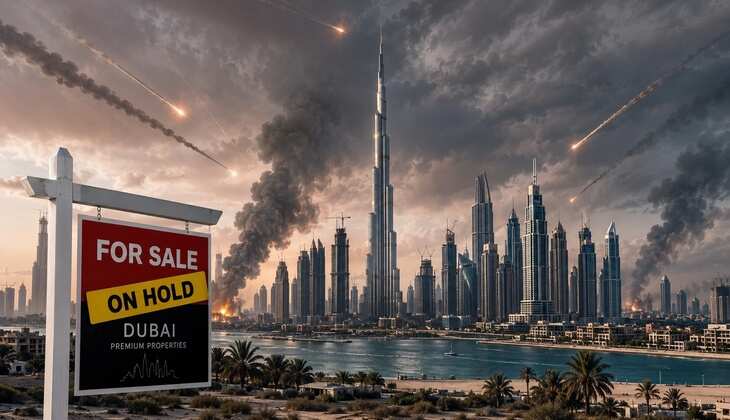
For years, Dubai’s property market seemed immune to the turbulence that plagued the rest of the region. No longer.
The military conflict involving Iran, the United States, and Israel — which reached UAE soil in late February and early March 2026 — has delivered a sharp and sudden blow to what was, just months ago, one of the world’s most exuberant real estate markets. Over 1,130 projectiles reportedly targeted UAE and Gulf infrastructure, including areas near Dubai International Airport and Zayed International Airport. Although the UAE’s air defences intercepted over 95% of these threats and no direct damage to major real estate assets was reported, the strikes created a significant “sentiment shock” among international investors, disrupting the long-held perception of the UAE as a perpetually safe destination for wealth.
Financial Fallout
The financial fallout was swift. UAE real estate transaction values fell by 51% month-on-month in the first half of March 2026, with year-on-year declines of 31% and 42% in the first and second halves of the month respectively. The Dubai Financial Market Real Estate Index plunged approximately 21% following the outbreak of the conflict, erasing the entire gains of 2025 within days. Developer bonds, including those from Binghatti Holding and Omniyat Holdings, also slipped into distressed territory.
Goldman Sachs noted that transaction values were down 42% year-on-year, largely driven by weakness in the secondary market — down 59% year-on-year — and particularly in the villa segment, which fell 89% year-on-year. The drop appears steeper than during previous disruptions, including the Dubai floods of April 2024 and the Iran-Israel flare-up of November 2024.
Construction Delays Mount
On the ground, the construction sector has been hit by supply chain disruptions and soaring material costs. Developers are now facing delays of six to twelve months in delivering new homes. Of the 45,000 units initially targeted for handover in Dubai in 2026, approximately half are now expected to be pushed to 2027 or even later, with many projects still in the early construction phases of 0–20%, making them highly vulnerable to further disruption.
The rental market has also softened. The March 2026 Residential Values report from ValuStrat showed that the property market faced its first downturn since the Covid-19 pandemic, falling by an average of 5.9%, and rental transactions remained 12.5% below March 2025 levels. “In the first two weeks we saw a complete pause in the market,” one industry veteran noted. “Buyers, especially investors, are less risk-averse and looking for answers and clarity surrounding travel, tourism, supply chains and the wider economy.”
Long-Term Outlook
The turmoil comes at a delicate moment. The conflict layers onto pre-existing concerns about incoming supply and potential pricing fatigue after a 60% price increase in Dubai real estate between 2022 and the first quarter of 2025. Off-plan sales — which accounted for 65% of all transactions in 2025 — are particularly exposed, as persistent investor hesitation could slow absorption rates and squeeze developer cash flows.
Despite the turbulence, analysts are not writing off the emirate’s long-term prospects. Analysts broadly agree that Dubai’s property sector remains underpinned by strong economic fundamentals, infrastructure investment, and sustained foreign capital inflows, which are expected to support long-term market stability and growth. The UAE’s real estate sector enters this period with strong underlying fundamentals — lower leverage, stronger regulation, a deeper population base, and a significant non-oil GDP — suggesting a potential recovery within months to years.
For now, however, the market is in a wait-and-see mode. The question is not whether Dubai’s property sector will recover, but how long the region’s conflict will continue to test its resilience.
