
Jaishankar on India-China Business Relations: 'Not Closed to Business, But on Our Terms' - All You Have To Know
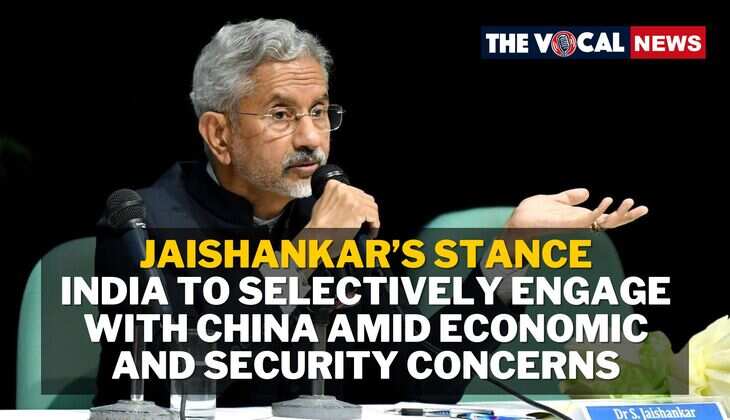
In a significant statement, External Affairs Minister S. Jaishankar emphasized that India remains open to business with China, but it will engage selectively and strategically. Speaking at a conference in Berlin, Jaishankar noted that while India is not entirely shutting the door on economic ties with China, it will exercise caution in determining which sectors to collaborate in and on what terms. This nuanced position reflects India’s broader approach towards China post-Galwan, where geopolitical tensions have impacted business engagements between the two Asian giants.
A Delicate Balance: Business vs. Security Concerns
The deadly Galwan clash in 2020 between Indian and Chinese forces marked a turning point in the bilateral relationship, triggering a wave of political and economic scrutiny in India. Since then, the Indian government has tightened its restrictions on Chinese investments, particularly in sensitive sectors such as telecommunications, technology, and infrastructure. Major Chinese projects were halted, and visa restrictions for Chinese nationals were introduced, further cooling the business climate.
However, as Jaishankar pointed out, India’s stance is not as binary as it may seem. While relations remain strained due to security concerns, economic pragmatism is pushing for selective re-engagement. “We are not closed to business from China,” Jaishankar said, but clarified that the critical question lies in which sectors India chooses to collaborate and how it structures these partnerships. His statement suggests a shift towards a more nuanced policy, where security considerations coexist with the need for economic cooperation.
Rethinking Chinese Investments: A Sectoral Approach
India’s recent policy towards Chinese investments has been one of caution, especially in sectors deemed sensitive to national security. But the conversation is evolving. According to reports, India could ease restrictions on Chinese investments in non-sensitive sectors such as solar panels and battery manufacturing—areas where the country lacks domestic expertise and capacity. These industries are critical for India's ambitions in renewable energy and electric mobility, making them ripe for collaboration with China, a global leader in both fields.
In this context, India’s strategy could be twofold: while blocking Chinese investments in sectors like telecommunications and data infrastructure, it may encourage collaboration in areas where China’s technological expertise aligns with India's manufacturing gaps. This pragmatic approach could allow India to tap into China’s resources without compromising national security.
The Push for Economic Integration
The call for renewed business ties with China is not just coming from Jaishankar. Indian officials, including Finance Minister Nirmala Sitharaman, have recently supported the idea of allowing more Chinese investment, particularly in sectors that can boost India’s global exports. This sentiment was echoed in India’s annual economic survey released in July, which suggested that India could either integrate into China’s supply chain or promote foreign direct investment (FDI) from China to bolster its manufacturing and export capabilities.
China’s dominance in global supply chains presents both a challenge and an opportunity for India. On the one hand, India is wary of becoming overly dependent on Chinese imports, especially in critical sectors like electronics and pharmaceuticals. On the other hand, there is a growing recognition that Chinese investment, if managed carefully, could help India fill gaps in its manufacturing sector, particularly in emerging technologies like solar energy and electric vehicle batteries.
Visa and Investment Scrutiny: A Barrier to Progress
Since the 2020 clash, India has virtually blocked visas for Chinese nationals, including technicians and business professionals, further complicating business relations between the two countries. Investments worth billions of dollars have been stalled, impacting sectors that rely on Chinese expertise.
However, there are indications that India may consider easing visa restrictions, particularly for Chinese technicians working in critical sectors like manufacturing and infrastructure. This would mark a significant shift in India’s post-Galwan policy and signal a willingness to re-engage with China on economic terms, albeit with a focus on protecting national security interests.
Navigating a Complex Relationship
The relationship between India and China is complex, shaped by both geopolitical tensions and economic interdependence. While the Galwan clash brought security concerns to the forefront, India cannot afford to completely sever business ties with China, given the latter's role as a global manufacturing powerhouse.
Jaishankar’s statement reflects this delicate balance. By selectively engaging with China, India aims to protect its strategic interests while benefiting from Chinese expertise in sectors where it lacks domestic capabilities. The challenge for India will be to navigate this balance effectively, ensuring that economic gains do not come at the cost of national security.
India’s approach to business with China is evolving, with a focus on strategic sectoral engagement rather than blanket restrictions. As External Affairs Minister S. Jaishankar highlighted, the issue is not whether India will do business with China, but in which sectors and under what terms. This pragmatic approach reflects the realities of the modern global economy, where economic and security concerns are increasingly intertwined. By carefully managing its business relationship with China, India aims to leverage Chinese expertise while safeguarding its strategic interests, a balancing act that will shape the future of bilateral ties.
