
The Man in the Shadows: The Many Lives of Vivek Nagpal
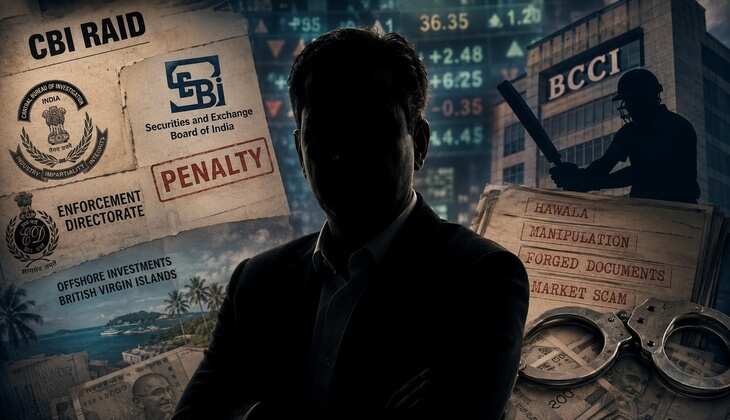
He is not a name that appears in bold type on business pages or flashes across the ticker at the bottom of a financial news screen. Yet for anyone who has spent time tracking the murky intersections of money, power, and impunity in India, Vivek Nagpal is a figure who keeps surfacing — in CBI raid notices, SEBI adjudication orders, Enforcement Directorate reports, and the incendiary tweets of a disgraced cricket administrator firing accusations from self-imposed exile in London. Lalit Modi, the former IPL commissioner, labelled Nagpal "the biggest hawala operator" and alleged he was closely associated with Omita Paul, the then-secretary to President Pranab Mukherjee. Whether or not that charge holds legal water, it crystallised a portrait of a man who has spent decades at the precise junction where corporate India and political India quietly transact.
The Making of a Market Player
Nagpal’s public trail begins in the boom years of Indian capitalism, when economic liberalisation cracked open a market long locked behind licence-raj walls. In that window of regulatory infancy and investor euphoria, a certain kind of operator flourished — someone who understood that the gap between a company’s stated worth and its traded price could be engineered, not merely discovered. Nagpal was closely associated with Ketan Parekh, the Mumbai-based stockbroker who became one of the most notorious figures in Indian financial history, and who owned stakes in two of Nagpal’s firms: Shonkh Technologies, which dealt in automobile number plates and smart cards, and Padmini Polymers, later rechristened Padmini Technologies.
Parekh, the so-called “Pentafour Bull,” artificially rigged prices of certain chosen securities using large sums of money borrowed from banks, and was eventually convicted in 2008 and sentenced to one year in prison, with a further conviction in a special CBI court in March 2014 earning him two years of rigorous imprisonment. Nagpal was among those in Parekh’s orbit when the entire edifice collapsed.
The Padmini Affair
Central to Nagpal’s regulatory reckoning is the saga of Padmini Technologies. The CBI alleged that Padmini Technology shares were sold to SBI Mutual Fund and UTI in off-market trading, and that their listing on exchanges was done by submitting forged documents. The transaction was conducted through various brokers, including Ketan Parekh, in what resulted in losses of over Rs 62 crore for SBI Mutual Fund. CBI searches were conducted at 12 premises in Delhi, five in Mumbai, and 11 in Kolkata, including the residences and offices of Parekh, Padmini Technology’s managing director Vivek Nagpal, and the then-managing director of SBI Mutual Fund.
SEBI ultimately imposed a fine of Rs 30 lakh against Padmini Technologies, finding that it had “seriously compromised the securities market regulatory framework to the detriment of investors,” and noted that its scrip was suspended in 2002 for penal reasons. The regulator further noted that Padmini Technologies had failed to attend to 270 demat requests since 2002, leaving investors in limbo.
The troubles did not end there. In 1997, the Enforcement Directorate had already unearthed massive over-invoicing of exports linked to Padmini Technologies. Delhi Customs had raided a Music World facility in the Noida Export Promotion Zone and found that CD-ROMs manufactured there were sold well below market rate to Padmini Technologies, which then exported the product at a significantly higher price. A Directorate of Revenue Intelligence report was categorical: the over-invoicing had resulted in evasion of customs duties and contravention of revenue laws. Padmini Technologies subsequently declared nil income in its tax returns — an assertion that strained credulity given the volumes passing through it.
The Offshore Trail
When the formal economy became too scrutinised, the money allegedly moved offshore. The Enforcement Directorate suspected that Nagpal had invested a substantial portion of the money made during the market manipulation into the British Virgin Islands. The vehicle was a company called Grand Accent Overseas, incorporated by Nagpal and his wife Aarti, with a registered address at H-27/1 Sainik Farm in Delhi. The Virgin Islands — a jurisdiction that requires minimal disclosure and offers maximal opacity — is the classic destination for funds seeking distance from domestic regulators.
Nagpal also continued running Padmini Financial Services Limited, a stock broking firm in which Aarti Nagpal was listed as a co-director — a family arrangement that kept corporate threads close to home even as money allegedly moved thousands of miles away.
The BCCI Connection
Around two years before the 2015 exposé, Lalit Modi had named Nagpal as the man who manipulated appointments and elections to the BCCI, and alleged he had links to several BCCI top-guns. Nagpal was also among a group of businessmen and bureaucrats whose phones were tapped by a private detective agency that had simultaneously targeted senior politicians, including Arun Jaitley. Delhi Police investigations into that phone-tapping operation revealed a surveillance net cast over anyone with significant proximity to cricket’s governing body in India.
Cricket, in Modi’s telling, was never just a sport. It was a business — one that generated sponsorships, broadcast rights, and franchise fees worth billions, all flowing through an organisation with limited external accountability. That Nagpal’s name surfaced here suggests a figure who moved across sectors with ease: equities one decade, cricket administration the next.
Allegations and Their Weight
It is necessary to note what is alleged and what has been legally established. The “hawala operator” label attached to Nagpal by Lalit Modi is an accusation made by a man who himself faces serious charges in India and was living in exile at the time. Modi uploaded a 100-page document to support his allegations, claiming to detail Nagpal’s business dealings, the favours extended to him by government, and his connections to at least five top bureaucrats. That document has never been independently verified in a court of law.
What is documented, however, is extensive enough. SEBI penalties against Nagpal personally and against Padmini Technologies are on the public record. The adjudicating officer imposed penalties on Padmini Technologies and on Vivek Nagpal himself, and when both parties appealed before the Securities Appellate Tribunal, the SAT directed them each to deposit Rs 1.5 lakhs with SEBI. CBI raids on his offices and home are established fact. The ED’s findings on export over-invoicing are in the formal record.
A Portrait of Impunity
What makes Vivek Nagpal a genuinely significant figure in the landscape of Indian financial wrongdoing is not the specific quantum of any one fraud, but the pattern — the way regulatory censure, criminal investigation, and damaging public allegations seem to have accumulated around him over decades without resolving into anything final. Fines were levied. Appeals were filed. Penalties were deposited. The machine ground on, and the man remained in circulation.
In India’s shadow economy, that is precisely the system working as designed by those who benefit from it. The hawala network — whether or not Nagpal operates within it — thrives not because it is invisible, but because the formal mechanisms meant to constrain it move slowly, tire easily, and are often pointed in the wrong direction by the very hands they are meant to bind. Vivek Nagpal’s career, as documented across two decades of regulatory filings and investigative reporting, is a case study in how that works in practice.
