
Who is Vikas Yadav: Ex-Indian Spy Charged in Foiled Plot to Kill Sikh Activist Pannun
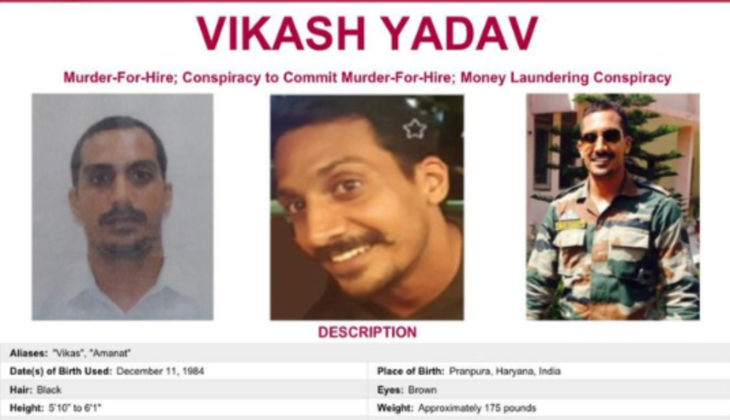
Vikas Yadav, a former Indian intelligence officer, has been charged in the United States for allegedly orchestrating a plot to assassinate Sikh separatist leader Gurpatwant Singh Pannun. The indictment was unsealed on Thursday by U.S. federal prosecutors from the Southern District of New York, accusing Yadav of involvement in a foiled murder-for-hire scheme aimed at eliminating Pannun, a vocal advocate for a separate Sikh homeland and a critic of the Indian government.
The Charges Against Vikas Yadav
According to the U.S. Justice Department, Yadav, 39, previously worked for the Indian government, specifically within the Cabinet Secretariat, which oversees India’s foreign intelligence agency, the Research and Analysis Wing (RAW). Yadav has been charged with three major offenses: conspiracy to commit murder-for-hire, conspiracy to commit money laundering, and participation in a murder-for-hire plot. U.S. authorities have stated that Yadav remains at large, with a federal warrant for his arrest issued on October 10, 2023.
Ex-RAW official declared wanted by FBI in Gurpatwant Pannun case. pic.twitter.com/LQc4FNJ4v8
— Parteek Singh Mahal (@parteekmahal) October 18, 2024
Details of the Assassination Plot
The indictment outlines that Yadav and his co-conspirators, including Nikhil Gupta, were allegedly part of a larger plan to kill Pannun in New York City in early May 2023. Pannun, a prominent Sikh political activist, is the leader of Sikhs for Justice, a group that advocates for the secession of Punjab from India to create an independent Sikh state, referred to as Khalistan. This movement has drawn considerable criticism from the Indian government, which views it as a threat to the country’s territorial integrity.
The FBI has described Yadav as an employee of the Indian government at the time of the plot, working with operatives both in India and abroad to carry out the assassination. Nikhil Gupta, Yadav’s co-conspirator, was arrested in Czechoslovakia last year and has since been extradited to the United States, where he currently remains in custody.
U.S. Response and FBI's Stance
The FBI and U.S. officials have taken the charges against Yadav seriously, viewing the plot as a violation of U.S. sovereignty and a threat to individuals exercising their constitutional rights. In a statement, FBI Director Christopher Wray emphasized that the agency would not tolerate acts of violence or retaliation against individuals living in the U.S. who are engaged in political activism. The indictment and the FBI's wanted poster for Yadav signal a clear message that U.S. law enforcement agencies will pursue justice in cases involving politically motivated violence.
Gurpatwant Singh Pannun’s Reaction
In response to the indictment, Pannun welcomed the charges against Yadav but referred to him as a "mid-tier soldier" in a broader scheme directed by high-ranking Indian officials. He alleged that Ajit Doval, India’s National Security Adviser, and Samant Goel, the former RAW chief, were behind the plot, orchestrating the attack as part of a wider strategy by Prime Minister Narendra Modi’s administration to quash Sikh separatist movements abroad.
Pannun has been a long-time target for his outspoken support of Khalistan, and his activism has placed him at odds with the Indian government. His organization, Sikhs for Justice, has been banned in India, and he has faced numerous legal challenges for his secessionist activities.
Indian Government's Denial
Reacting to the charges, the Indian government has distanced itself from Yadav, stating through diplomatic channels that he is no longer employed by the government. On Wednesday, India conveyed to the U.S. State Department that Yadav had no current ties to the Indian intelligence services, denying any official involvement in the plot. Despite this, the charges have added another layer of tension between India and the U.S., particularly in regard to how political dissent and activism are handled across borders.
The Larger Context
This case highlights the growing complexity of global political activism, especially with movements like Khalistan gaining traction among diaspora communities. The alleged plot against Pannun underscores the risks faced by activists, even when operating outside their home countries, and the lengths to which states may go to counter perceived threats.
As the U.S. continues its investigation and search for Yadav, the case is likely to have far-reaching implications for international relations and political dissidents.