
India's First Bullet Train Finally Has a Date, but Is the Country Actually Ready to Compete on High Speed Lane?
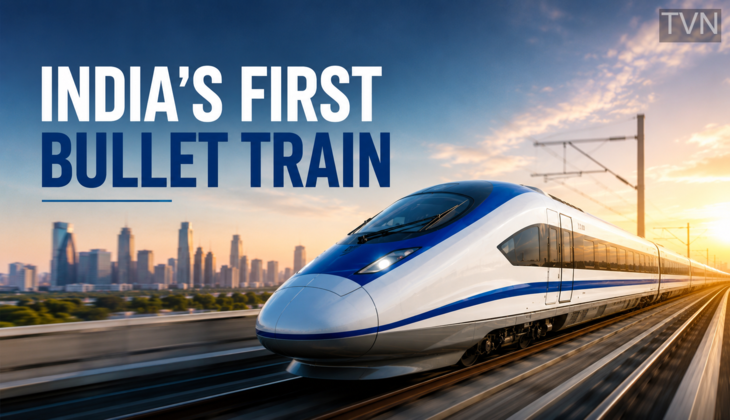
For years, India's bullet train has existed mostly as a rendering of a shiny animation of a white and blue train gliding past Gujarat's countryside, trotted out at press conferences while the actual construction crawled along in the background. That's starting to change. Railway Minister Ashwini Vaishnaw has now put a real date on the calendar, and for the first time, the promise of Indian high speed rail feels less like a slogan and more like a countdown.
But a launch date raises a bigger question than "when." It raises "how far behind everyone else are we, and can this one line actually change that?"
The Timeline, As Vaishnaw Laid It Out
Speaking at an event in Hyderabad, Vaishnaw said the first operational stretch of the Mumbai Ahmedabad High Speed Rail corridor, the Surat Bilimora section, is set to begin passenger services from August 15, 2027. Nearly 80 percent of the overall project is complete, he said, with construction moving quickly enough to meet that target.
Rather than opening all 508 kilometres in one go, the corridor will roll out section by section. After Surat Bilimora comes online, the plan is to extend outward in stages: Vapi Surat, then Vapi Ahmedabad, followed by Ahmedabad Thane, and finally Ahmedabad Mumbai, the last and most complex leg given the undersea tunnel and dense urban terrain around Mumbai's Bandra Kurla Complex.
Vaishnaw also used the moment to look beyond this one corridor. He confirmed three more high speed lines centred on Hyderabad: Pune Hyderabad, Hyderabad Chennai, and Hyderabad Bengaluru, describing Hyderabad as a future "high speed hub" for the southern region. It's part of a broader ambition, floated separately by the ministry, of seven new bullet train corridors eventually crisscrossing the country.
The Progress Is Real, and So Are the Scars
Credit where it's due: the Mumbai Ahmedabad line is no longer a paper project. All of the 1,389.5 hectares of land needed have been acquired, every statutory clearance is in place, and more than 1,600 utility lines have been shifted out of the way. Seventeen bridges are complete, tunnel boring machines are grinding through Maharashtra's hillsides, and once operational, the line will cut Mumbai Ahmedabad travel time from roughly six hours to under two.
But getting here wasn't smooth, and it's worth being honest about why. Land acquisition disputes in Maharashtra stalled the project for years between 2019 and 2021, largely because of political resistance from the state government at the time, while Gujarat's side of the corridor, where eight of the twelve planned stations sit, moved far faster. Costs climbed too. By early 2026, the project's total cost had risen by roughly 83 percent over the original estimate, driven mostly by land price inflation during those delayed years. There's also a quieter financing wrinkle. Tension in the India Japan relationship has created some uncertainty about who picks up future cost overruns beyond the original JICA loan, with the expectation increasingly falling on the Indian government rather than additional Japanese financing.
None of that erases the progress. But it's a reminder that India's first brush with high speed rail has been shaped as much by domestic land politics and financing friction as by engineering.
So, Is India Actually Ready to Compete Globally?
This is where the picture gets more sobering, because "ready" depends entirely on what you're comparing against.
On scale, India isn't close, and won't be for a long time. China's high speed network has already crossed 45,000 kilometres, more than the rest of the world combined, with plans to push past 70,000 kilometres by 2035. Japan, the original pioneer, runs a comparatively modest but famously reliable network of roughly 3,000 kilometres across nine Shinkansen lines. India's entire high speed ambition, once every planned corridor is built, would still be a fraction of what China alone has already laid down.
On speed, India is deliberately starting a notch below the leaders. The domestically built trains for the Mumbai Ahmedabad corridor are being engineered for an average cruising speed of 250 km/h and a top speed of 280 km/h. That's respectable, but it trails Japan's Shinkansen, which runs regularly at up to 320 km/h, and China's Fuxing Hao trains, which operate commercially at up to 350 km/h, with China's next generation CR450 targeting 400 km/h. In other words, India's first bullet train will be genuinely fast by Indian standards and merely adequate by the standards of the countries it's often compared to.
On technology transfer and self reliance, there's a real foundation being built. The corridor is based on Japan's Shinkansen system, prized for its five decade safety record of zero passenger fatalities from accidents. BEML has been contracted to build the rolling stock domestically, with the prototype expected this year, a meaningful step toward manufacturing capability rather than permanent dependence on imports. China took a similar path two decades ago, licensing Japanese and European technology before developing its own trains and eventually becoming an exporter itself. India is, in effect, standing where China stood in the mid 2000s.
On execution speed, the comparison is genuinely uncomfortable. China went from its first high speed line in 2008 to the world's largest network within about fifteen years. India, by contrast, will have taken roughly a decade just to open the first operational stretch of a single corridor, from the 2017 groundbreaking to the 2027 target. Some of that gap is fair. India's democratic land acquisition process, densely populated corridors, and coalition era politics don't map neatly onto China's centrally planned, state directed model. But it does mean India can't simply will its way to Chinese style scale on a similar timeline.
What "Competing Globally" Actually Requires From Here
India isn't trying to out build China, and realistically, it shouldn't try. The more useful goal is building a reliable, safe, and gradually expanding high speed spine starting with Mumbai Ahmedabad, then extending into the Hyderabad corridors and beyond while using this first line to develop the domestic manufacturing, maintenance, and engineering ecosystem that China spent two decades building before it became a global exporter of the technology.
The 2027 date is a genuine milestone, not just a political one, even though the timing landing conveniently ahead of the 2029 general election hasn't gone unnoticed by commentators tracking the project's politics as closely as its engineering. But a single 508 kilometre corridor, opened in stages and running at 250 km/h, doesn't make India a global high speed rail competitor on its own. What it can do is prove the model works on Indian terrain, with Indian institutions, at Indian cost, and that proof is the actual prerequisite for everything else on the seven corridor wishlist. Global competitiveness in high speed rail isn't won with one line. It's won with the fifteenth, when the delays are behind you, and the manufacturing base is fully your own.