
Delhi Metro Closes 16 Stations as Student Protests Turn Violent
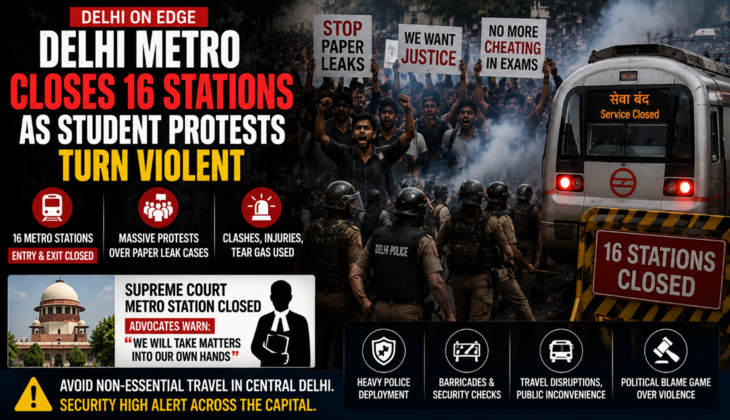
Security across the national capital was significantly tightened after violent clashes between protesters and police led to the temporary closure of entry and exit gates at 16 major Delhi Metro stations. The restrictions were imposed as authorities attempted to control large demonstrations linked to the nationwide outrage over paper leak cases.
According to officials, thousands of students, supported by political activists and members of the Cockroach Janta Party (CJP), gathered in central Delhi demanding stronger action against those responsible for repeated examination leaks. As the protests intensified, confrontations broke out late at night between demonstrators and security personnel.
Several police officers and protesters reportedly sustained injuries during the clashes. Videos circulating on social media showed barricades being pushed, tear gas shells being fired, and heavy police deployment in sensitive areas. Authorities appealed to the public to avoid unnecessary travel in central Delhi until the situation returned to normal.
Delhi Metro Rail Corporation (DMRC) temporarily restricted access at several strategically located stations based on security advisories issued by Delhi Police. While train services continued on most routes, passengers faced inconvenience due to limited station access and increased security checks.
Political leaders have exchanged blame over the violence. Opposition parties accused the government of failing to address students' concerns, while the ruling establishment alleged that certain groups attempted to exploit the protests for political purposes.
Security agencies remain on high alert, with additional police forces deployed around government buildings, examination authorities, and key transportation hubs. Officials have urged protesters to maintain peace while assuring that lawful demonstrations would be respected.
The protests highlight growing frustration among India's youth over examination transparency and employment opportunities, making education reforms a major national issue.
Meanwhile, the closure of the Supreme Court Metro Station has also drawn strong reactions from the legal fraternity. An advocates' body has reportedly warned that if authorities do not reopen the station soon, lawyers will be forced to "take matters into their own hands." The association argued that the prolonged closure is severely affecting advocates, litigants, and court staff who depend on the Metro for daily access to the Supreme Court and nearby judicial institutions. The statement has added another layer of pressure on authorities as security concerns continue to dominate the capital.