
IBM Suffers Biggest Stock Drop in Decades as Earnings Warning Wipes Out $70 Billion
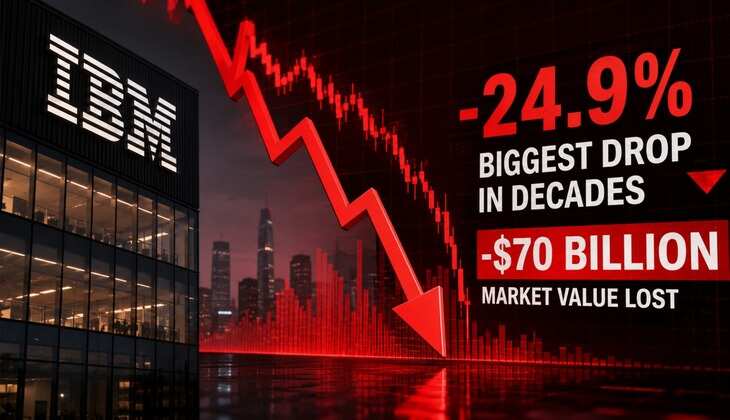
One of the biggest names in the technology industry has suffered one of the biggest market shocks in its history. IBM's shares plunged nearly 25% in a single trading session after the company warned investors that its second-quarter financial results would fall short of expectations. The sharp decline wiped out around $70 billion in market value, sending shockwaves across global markets and raising fresh concerns about spending trends in the technology sector.
The fall marks IBM's worst single-day stock decline in more than five decades and highlights how quickly investor confidence can disappear when a major technology company reports weaker-than-expected business performance.
What happened?
The selloff began after IBM released preliminary results for the second quarter, well before its scheduled earnings announcement. The company said it expects revenue of about $17.2 billion, below Wall Street's estimate of nearly $17.9 billion. Adjusted earnings are also expected to miss analyst forecasts.
IBM CEO Arvind Krishna acknowledged that the company had not responded quickly enough to changing market conditions. In a letter to investors, he said several large business deals were delayed and customers shifted more of their technology budgets toward servers, storage and memory infrastructure instead of some of IBM's traditional software and infrastructure offerings.
What does "wiping out $70 billion" actually mean?
The phrase "wiping out $70 billion in market value" does not mean IBM lost $70 billion in cash. Instead, it means the total value of the company's shares in the stock market dropped by about $70 billion in a single day because investors sold the stock aggressively. Since a company's market value is calculated by multiplying its share price by the total number of outstanding shares, a sharp fall in the stock price can erase billions of dollars in value almost instantly.
For shareholders, this means the value of their investments fell significantly. Pension funds, mutual funds, exchange-traded funds (ETFs), institutional investors and employees holding IBM stock all saw the value of their holdings decline.
Why did investors react so strongly?
Markets generally expect large technology companies like IBM to deliver stable growth.
However, IBM's warning suggested that businesses are changing how they spend money on technology. Instead of investing heavily in software and consulting, many companies are prioritising AI infrastructure such as servers, storage systems and memory to prepare for growing AI workloads.
IBM also admitted that it failed to close several large customer deals during the quarter, adding to concerns that its growth could slow further if customer spending remains cautious.
What impact could this have?
Although the decline is specific to IBM, it has wider implications for the technology and business sectors.
Investors may become more cautious toward enterprise software companies until upcoming earnings reports provide greater clarity. Companies that depend on corporate technology spending could face increased scrutiny from investors.
The development also reinforces a broader shift in the AI market. Investors are currently rewarding companies that provide AI chips, servers and cloud infrastructure more than those whose growth depends mainly on software spending.
For businesses, the news suggests that many organisations are carefully prioritising technology budgets rather than increasing overall spending. That trend could affect software vendors, IT consulting firms and cloud service providers over the coming quarters.
Could this affect India?
IBM has a significant presence in India and works with enterprises, banks, government organisations and technology partners.
While the earnings warning does not directly affect IBM's operations in India, analysts believe slower enterprise technology spending globally could influence sentiment across the broader IT services sector. However, the impact on Indian IT companies will depend on their own earnings and customer demand rather than IBM's performance alone.
What should investors do now?
Financial experts generally advise investors against making decisions based only on one day's market movement.
A sharp fall in a company's stock price can sometimes reflect temporary concerns, while in other cases it may signal deeper business challenges. Investors typically watch future earnings reports, management's recovery plans and customer demand before deciding whether to buy, hold or sell.
Diversification also remains important. Concentrating investments in a single company's shares can expose investors to significant losses if that company faces unexpected setbacks, as IBM's recent decline has demonstrated.
A reminder of how quickly markets can change
IBM's historic stock decline is a reminder that even some of the world's oldest and most established technology companies are not immune to changing market trends. As businesses redirect spending toward AI infrastructure and demand greater returns on technology investments, companies across the sector will face increasing pressure to adapt quickly. For investors and markets alike, the coming earnings season will provide a clearer picture of whether IBM's troubles are company-specific or part of a broader shift in global technology spending.