
Number of Indians declaring ₹100 crore-plus income has quadrupled in five years, govt tells Parliament
Government data presented in Parliament shows the number of Indians reporting annual incomes of ₹100 crore or more has risen from 142 to 576 in five years, highlighting the country's growing base of ultra-high-income taxpayers even as the government points to improving inequality and employment indicators.
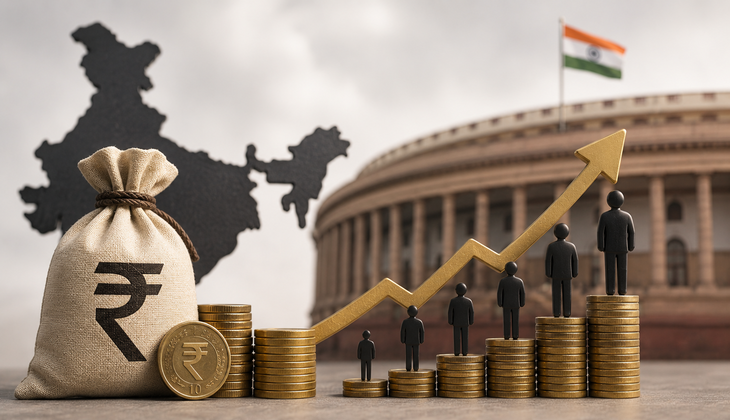
New Delhi: India's very top earners are no longer a handful. Tax return data placed before Parliament on Monday shows that 576 individuals declared a gross total income of ₹100 crore or more for assessment year 2025-26 — more than four times the 142 people who reported that level of income five years ago.
The figures came from Minister of State for Finance Pankaj Chaudhary, in a written reply in the Lok Sabha to a question on whether the government had taken note of the rising number of billionaires in the country and India's standing among nations on that count.
The year-wise trend is uneven but sharply upward. From 142 in AY 2021-22, the count jumped to 301 the following year, slipped to 284 in AY 2023-24, then climbed to 415 in AY 2024-25 before touching 576 in the latest assessment year. The dip in 2023-24 aside, the direction of travel over the five-year window is unmistakable.
Chaudhary was careful with terminology. Neither the Income-tax Act, 2025 nor the older Income-tax Act, 1961 actually defines what a billionaire is, he pointed out — "There is no statutory definition of the term 'billionaire'". What the tax department does track is the number of filers crossing the ₹100 crore gross total income mark, which is the closest official proxy available.
The minister also made clear that the government has no ledger of how much India's wealthiest are actually worth. The Wealth-tax Act, 1957 was scrapped with effect from April 1, 2016, and since then no data on the aggregate wealth of taxpayers has been maintained. Income and wealth are different things, and only the first is being counted here.
Anticipating the inequality argument that usually follows such numbers, the reply put a set of counter-indicators on record. The Household Consumption Expenditure Survey for 2023-24 showed the Gini coefficient falling to 0.237 in rural India from 0.266 a year earlier, and to 0.284 in urban India from 0.314. The Gini scale runs from 0, or perfect equality, to 1, or complete concentration, so a falling figure points to consumption spreading more evenly and the rural-urban gap narrowing.
The government further cited a drop in the unemployment rate for those aged 15 and above, from 3.6 per cent in 2022 to 3.1 per cent in 2025, along with what NITI Aayog has reported as a significant decline in multidimensional poverty over the past decade.
On policy, Chaudhary listed the usual instruments: a progressive income tax structure, employment-linked tax incentives, support for start-ups and cooperatives, and welfare programmes spanning housing, healthcare, financial inclusion, skill development and rural livelihoods — the government's case being that growth at the top and broader inclusion are not mutually exclusive.