
Sonam Wangchuk's Fight for Education: The Legacy of a Father, a Son, and a Growing People's Movement
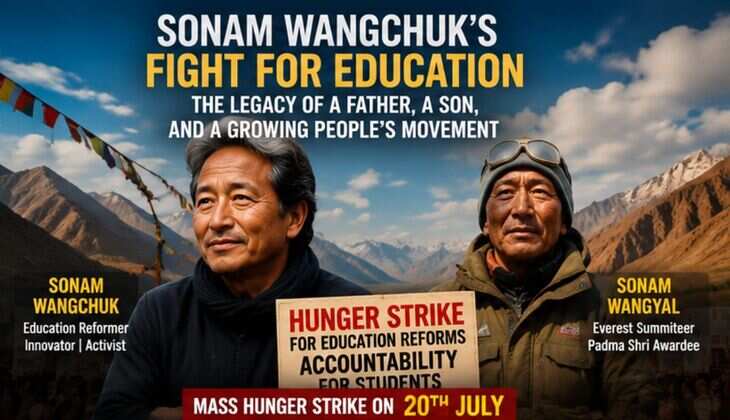
For many Indians, Sonam Wangchuk is known as the engineer and education reformer who inspired the character of Phunsukh Wangdu in the Bollywood film 3 Idiots. But beyond the film, Wangchuk has spent decades working to improve education, promote sustainable living, and protect the fragile environment of Ladakh. Today, he is once again in the national spotlight, this time because of his indefinite hunger strike demanding accountability in India's education system.
His protest has also brought attention to another remarkable figure from his family, his father, Sonam Wangyal, whose own achievements have inspired generations.
Who is Sonam Wangchuk?
Born in Ladakh in 1966, Sonam Wangchuk is an engineer, innovator, environmentalist, and education reformer. In 1988, he co-founded the Students' Educational and Cultural Movement of Ladakh (SECMOL), an organisation that focuses on practical learning instead of rote memorisation. Over the years, SECMOL has helped thousands of students who struggled in the traditional education system.
Wangchuk has developed several environmentally friendly innovations, including the famous "Ice Stupa" project, which stores winter water in the form of artificial glaciers to help farmers during the dry summer months. His work has earned national and international recognition, including the Ramon Magsaysay Award.
He has also been a strong voice for climate action, education reforms, and the rights of the people of Ladakh.
Sonam Wangyal: The Man Who Inspired Him
Sonam Wangchuk's father, Sonam Wangyal, is one of India's greatest mountaineers and explorers.
In 1965, at just 23 years of age, Sonam Wangyal became one of the youngest Indians to successfully climb Mount Everest. The expedition was a historic moment for India and helped establish the country's presence in Himalayan mountaineering.
He later served for decades with the Indo-Tibetan Border Police (ITBP), where he trained generations of mountaineers and contributed to high-altitude rescue operations and border expeditions. For his achievements, he received the Padma Shri and several other national honours.
Many believe Wangchuk's determination, discipline, and commitment to public service reflect the values passed on by his father.
Why is Sonam Wangchuk on Hunger Strike?
Since June 28, Sonam Wangchuk has been on an indefinite hunger strike at Delhi's Jantar Mantar. His protest supports the youth-led Cockroach Janta Party (CJP) movement, which has demanded the resignation of Union Education Minister Dharmendra Pradhan following allegations of examination irregularities, including the NEET paper leak controversy.
The movement says repeated paper leaks and examination failures have damaged the future of millions of students. Protesters are demanding greater transparency, stronger accountability, and major reforms in India's examination system.
As of July 16, Wangchuk has lost more than nine kilograms during the fast, and doctors have warned that his health could worsen if the protest continues. The Delhi High Court has directed authorities to monitor his health regularly while allowing medical intervention if required.
A Call for a Mass Hunger Strike on July 20
The protest is expected to enter a new phase on July 20, when supporters of the Cockroach Janta Party have announced a nationwide mass hunger strike and a march towards Parliament.
Organisers are urging students, teachers, parents, and citizens across India to participate peacefully in solidarity with Wangchuk and to demand reforms in the education system. The movement says its objective is to keep public attention focused on examination integrity, accountability, and student welfare.
More Than One Protest
Whether one agrees with his demands or not, Sonam Wangchuk's hunger strike has become more than a political protest. It has sparked broader discussion about the future of India's education system, the credibility of competitive examinations, and governments' responsibility to protect students' interests.
The story also highlights a unique family legacy. While Sonam Wangyal earned respect by climbing the world's highest mountain and serving the nation, his son has chosen a different path by trying to bring change through education, innovation, and peaceful public movements.
As the July 20 mobilisation approaches, all eyes will remain on whether the government responds to the growing demands or whether the protest continues to gather momentum across the country.