
12 Dead, 13 Still Trapped After Sikkim Tunnel Blast
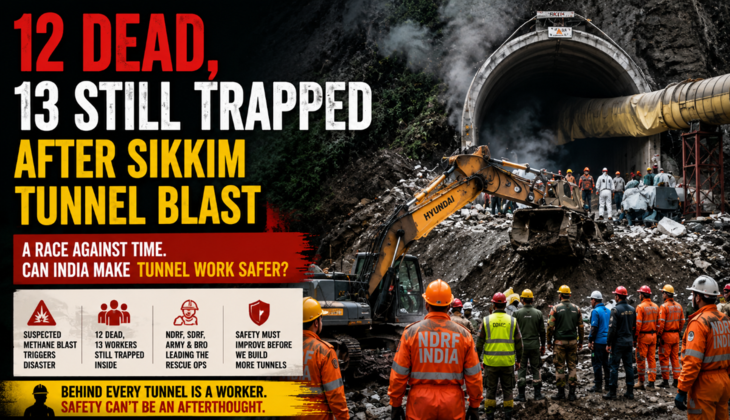
A normal day at work turned into a nightmare in Sikkim.
Workers had entered an under construction tunnel like they did every day. But within moments, everything changed. A suspected methane gas explosion shook the tunnel, filling it with dust, smoke and debris. Many workers managed to escape, but others were trapped deep inside.
So far, 12 workers have lost their lives, while 13 are still trapped. Rescue teams are working round the clock, hoping to bring every trapped worker out alive.
The accident has once again raised an uncomfortable question.
India is building bigger roads, longer tunnels and faster highways. But are we doing enough to protect the people building them?
What Exactly Happened?
The incident took place inside a tunnel being built in Sikkim, a state where many road and infrastructure projects are underway because of its difficult mountain terrain.
According to initial reports, methane gas may have collected inside a section of the tunnel. A spark is believed to have triggered a powerful explosion.
The blast damaged parts of the tunnel, causing rocks and concrete to collapse. Workers inside had little time to react.
Some managed to run out.
Others were buried under debris.
Within minutes, the construction site turned into a rescue zone.
Teams from the NDRF, SDRF, Army, BRO, police and local administration rushed to the site. Heavy machines, drilling equipment and rescue experts have been deployed, but reaching the trapped workers is proving to be extremely difficult.
Every hour matters because oxygen levels inside damaged tunnels can fall quickly.
The Hidden Danger Called Methane
Methane is one of the biggest dangers during underground construction.
It is a gas that cannot be seen. In many cases, it cannot even be noticed until it becomes dangerous.
If methane collects in a closed space like a tunnel and comes in contact with heat or a small spark, it can cause a deadly explosion.
This is why modern tunnel projects are expected to have continuous air circulation, gas monitoring systems and emergency evacuation plans.
Experts say that even a small mistake in safety checks can have tragic consequences.
Not the First Tunnel Tragedy
Sadly, India has seen similar accidents before.
In 2023, the country watched anxiously as 41 workers were trapped inside the Silkyara tunnel in Uttarakhand after a section collapsed. The rescue operation lasted more than two weeks and became one of the most difficult rescue missions in India's history.
All 41 workers were finally rescued safely.
The Sikkim accident has brought back memories of that incident.
It also reminds us that despite advances in engineering, tunnel construction remains one of the most dangerous jobs in the country.
India Is Digging More Tunnels Than Ever Before
India is investing heavily in roads, railways and hydropower projects, especially in the Himalayan region.
These tunnels are important. They improve connectivity, strengthen border infrastructure and reduce travel time.
But building tunnels in young and fragile mountains is never easy.
Engineers have to deal with weak rocks, water seepage, landslides, changing weather and dangerous underground gases.
This makes safety just as important as speed.
Experts say that while India has become better at building tunnels, it must now become equally good at protecting the workers inside them.
Can Safety Be Improved?
Many experts believe accidents like these can be reduced with better planning.
Every tunnel should have advanced gas detectors that give early warnings.
Fresh air systems should run continuously.
Emergency exits and safe shelters should be available at different points.
Workers should receive regular safety training and emergency drills.
Technology such as AI based monitoring, smart sensors and real time gas detection can also help identify danger before it turns into a disaster.
The cost of better safety may be high, but it is far lower than the cost of losing human lives.
Families Waiting for a Miracle
Outside the tunnel, the rescue operation is not just about machines.
It is about families waiting with folded hands and hopeful eyes.
Every update from rescue officials brings a mix of hope and fear.
For parents, wives and children, every passing hour feels like a lifetime.
The nation is watching and praying that more workers are brought out safely.
A Bigger Lesson for India
The Sikkim tunnel accident is not just another construction accident.
It is a reminder of the risks taken every day by thousands of workers who build the roads we travel on, the tunnels that connect our cities and the infrastructure that powers the country's growth.
India dreams of becoming a developed nation with world class infrastructure.
But development should never come at the cost of workers' lives.
Every tragedy should lead to stronger safety rules, better technology and stricter monitoring.
Because while tunnels can always be rebuilt, a lost life can never be brought back.
As rescue teams continue their difficult mission, one question remains.
Will this tragedy become another forgotten headline, or will it finally push India to make tunnel construction truly safe?