
The Great Indian Railway Theft: 1.27 Crore Missing Linen Items Tell a Bigger Story
Every time there is a scam or a case of corruption, many people are quick to blame the government or public institutions. But a recent investigation by The Indian Express raises a difficult question: What happens when ordinary citizens themselves become part of the problem?
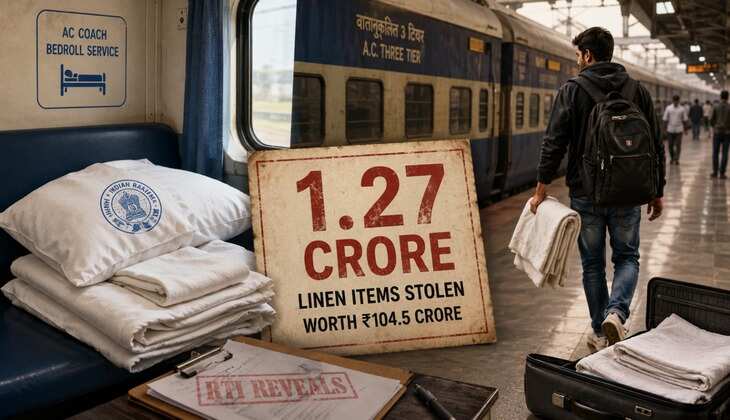
An RTI-based investigation by The Indian Express, one of India's leading national newspapers with a strong reputation for investigative reporting, has found that more than 1.27 crore bedroll and linen items, including bedsheets, towels, blankets, pillows and pillow covers, were stolen from air-conditioned coaches of Indian Railways between January 2022 and May 2026. The missing items are estimated to be worth more than 104.5 crores, revealing a pattern of everyday theft that quietly drains public resources.
The numbers may seem surprising, but what they reveal about civic responsibility and public behaviour could be even more significant.
A nationwide investigation
The findings are based on RTI applications filed by The Indian Express with all 69 railway divisions. Responses were received from 54 divisions across 16 of the 18 railway zones, with some divisions providing partial information.
According to the investigation, thefts increased by 56% between 2022 and 2025 after bedroll services resumed following the Covid-19 pandemic. Around 8 lakh passengers travel in AC coaches every night, and railway officials estimate that roughly one in every 1000 passengers walks away with at least one linen item.
The most commonly stolen item was the face towel, followed by bedsheets, pillow covers, blankets and pillows. Bikaner division reported the highest number of missing items, while just ten railway divisions accounted for nearly 67% of all reported thefts.
The hidden cost of a "free" towel
Many passengers may see a towel or bedsheet as a small souvenir from their journey. But these items are not complimentary.
Every bedsheet, pillow, blanket or towel belongs to Indian Railways and is meant to be reused for future passengers. When they disappear, they have to be replaced.
The investigation found that the financial burden often falls first on bedroll contractors, who then recover the money from coach attendants through salary deductions. Some attendants reportedly lose thousands of rupees every month despite having no control over passengers leaving the train with the items.
In other words, what appears to be a minor act of theft by one passenger may directly reduce the income of a low-paid railway worker.
The uncomfortable social angle
Perhaps the most uncomfortable aspect of the investigation is where these thefts are taking place.
The missing linen comes from air-conditioned coaches, not general compartments. AC tickets are considerably more expensive, meaning most passengers are likely to belong to middle-income, upper-middle-income or affluent households.
While income does not determine honesty, the findings challenge a common assumption that education or financial stability automatically leads to better civic behaviour.
The investigation suggests that access to money or education alone does not prevent unethical behaviour. Instead, it points to a deeper issue of public morality, where some people justify taking public property simply because the opportunity exists.
A mirror for society
The findings also expose an irony. Public debates often focus on corruption in government offices, misuse of taxpayer money or inefficiency in public services. Those concerns are valid. But public institutions are also weakened by the everyday actions of ordinary citizens.
Stealing a railway towel, damaging a public bench, avoiding taxes, vandalising buses or defacing monuments may seem like isolated acts. Collectively, however, they increase public spending, reduce service quality and ultimately make taxpayers bear the cost.
The Railway Ministry itself acknowledged the issue as a matter of serious concern and has begun exploring stricter measures to reduce such thefts, including stronger monitoring and possible legal action against offenders.
Not an isolated problem
This is not the first time Indian Railways has faced losses because of passenger behaviour. Over the years, railway authorities have repeatedly reported theft or damage involving taps, mirrors, charging sockets, fans, light fittings, dustbins and even train fixtures. Public transport systems across the world also deal with vandalism and theft, but the scale highlighted by this investigation shows that the problem remains significant in India.
Experts on public administration have long argued that good governance depends not only on honest governments but also on responsible citizens. Public infrastructure survives when people see it as shared property rather than something to exploit for personal gain.
More than missing bedsheets
The Indian Express investigation is ultimately about much more than missing towels or blankets. It highlights a gap between what citizens expect from public institutions and how some behave when no one is watching.
India is investing heavily in modernising its railway network with faster trains, upgraded stations and better passenger services. But maintaining these improvements requires more than government spending. It also depends on passengers respecting public property.
A bedsheet taken home from a train may appear insignificant. Yet when 1.27 crore such items disappear, the issue is no longer about linen. It becomes a reflection of civic values, accountability and the shared responsibility of protecting public resources.
The investigation serves as a reminder that building a better country is not only the responsibility of governments. It is also the responsibility of every citizen who uses the public services.