
The No Resignation Culture in BJP Government
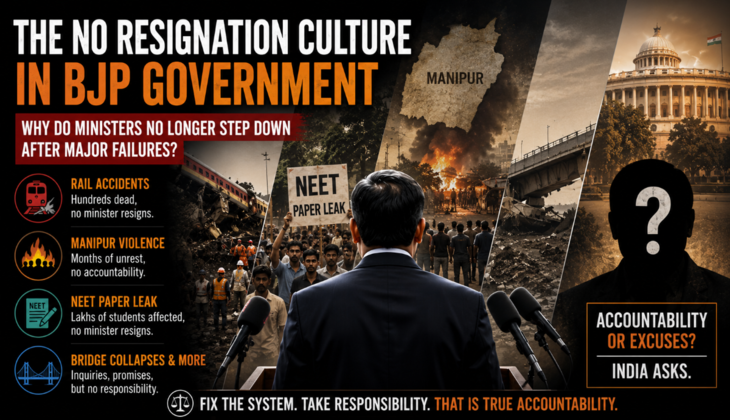
Whenever a bridge collapses, a train crashes, a paper leak ruins the future of lakhs of students, or violence breaks out in a state, one question always follows.
Who will take responsibility?
For many Indians, responsibility means more than an inquiry. It also means someone in power accepting that something went terribly wrong.
But in today's politics, resignations have almost disappeared.
Over the last decade, the BJP government has faced demands for ministers to resign after railway accidents, the Manipur violence, the NEET paper leak controversy, bridge collapses, and several other incidents. Yet, very few ministers have actually stepped down.
This has started a larger debate.
Has India entered an era where political resignations have become a thing of the past?
When resignations meant something
There was a time when resigning was seen as a sign of honesty.
The best example is Lal Bahadur Shastri.
In 1956, after a deadly railway accident, Shastri resigned as Railway Minister. Nobody blamed him for causing the accident. Yet he believed that if the railway failed, the minister had to accept moral responsibility.
His resignation became a lesson in political accountability.
Today, that idea seems to be fading.
The BJP's new way of looking at responsibility
The BJP government believes resignations do not solve problems.
Its argument is simple.
If a bridge falls or a train crashes, changing one minister will not fix weak systems built over many years.
Instead, the government says the focus should be on rescue work, investigations, punishing those directly responsible, and making sure the mistake is not repeated.
According to the BJP, governance is about solving problems, not making symbolic political sacrifices.
One example after another
The biggest example is the railway ministry.
After the Balasore train tragedy in 2023, which killed nearly 300 people, opposition parties demanded the resignation of Railway Minister Ashwini Vaishnaw.
The government refused.
Instead, it announced investigations, compensation for victims, expansion of the Kavach safety system, and improvements in railway signalling.
The minister stayed in office.
The same pattern was seen after other railway accidents in the following years.
Then came Manipur.
Months of ethnic violence left hundreds dead and thousands displaced. Once again, the opposition demanded accountability from the Centre.
No resignation followed.
The NEET paper leak controversy created another political storm.
Lakhs of students and their families protested after questions were raised over the fairness of one of India's biggest entrance examinations.
Again, there were investigations, arrests, and promises of stronger laws.
But no senior minister resigned.
The same debate has followed bridge collapses, exam leaks, and other administrative failures.
Politics has changed
Political experts say this is not only about one government.
Across the world, leaders today are less willing to resign because politics has become more competitive.
Every resignation is seen as a victory for the opposition.
Governments therefore choose to defend their ministers instead of replacing them.
A resignation today is often treated as admitting political failure.
That is why governments prefer to wait for investigations instead of acting immediately.
The opposition disagrees
Opposition parties believe this thinking is dangerous.
They say ministers are not expected to resign because they personally caused an accident.
They should resign because they lead the department where the failure happened.
This, they argue, is what political accountability means.
For them, a resignation sends a message that public office comes with responsibility.
Supporters see it differently
Supporters of the government have another view.
They ask a simple question.
If every minister resigns after every accident, who will complete the reforms?
According to them, solving the problem matters more than leaving the post.
They point out that railway safety projects, new examination laws, disaster response systems, and infrastructure reforms require continuity.
Replacing ministers after every crisis could slow down long-term work.
Is resignation enough?
This is where the debate becomes interesting.
Does a resignation really solve anything?
A minister may resign, but unless the system changes, another accident can still happen.
On the other hand, if nobody is held politically responsible, public trust may slowly disappear.
That is why many experts believe accountability should have two parts.
One is fixing the system.
The other is accepting responsibility when the system fails.
Both are equally important.
The bigger question
The debate is no longer about one minister or one government.
It is about the kind of democracy India wants.
Should ministers resign after every major failure, even if they were not personally involved?
Or should they stay in office and focus on correcting the mistakes?
There is no easy answer.
But every time a tragedy strikes, the same question returns.
If nobody in power is willing to step down, then what does political accountability really mean?