
Who gets to decide the fate of Assam’s rescued wildlife? Vantara proposal sparks a fresh controversy
Guwahati: A proposal that was presented as an opportunity to strengthen wildlife rescue in Assam has opened a much more difficult debate: could a rescue centre also become a pathway for taking rescued animals out of the Northeast?
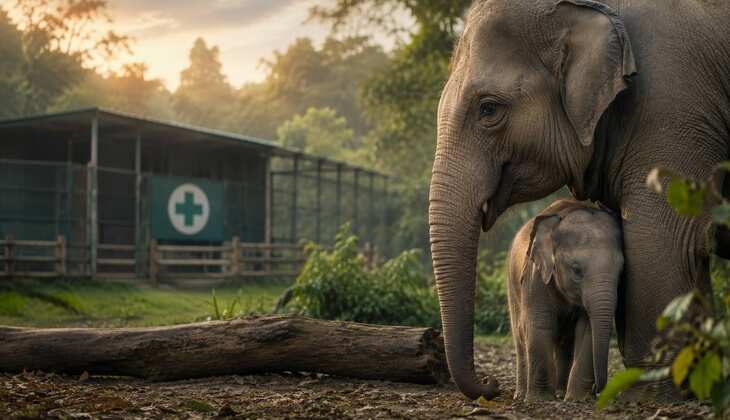
That is one of the key questions being raised by wildlife activists after Vantara proposed setting up three wildlife rescue and rehabilitation centres in Assam, including one exclusively for Asian elephants.
The proposal was submitted to Assam’s Environment, Forest and Climate Change Department on August 12. The state government has said it is examining the offer.
Vantara, the Jamnagar-based wildlife facility operated by Anant Ambani, has offered to bring its infrastructure and technical expertise to Assam. But conservationists say the government must look beyond the proposed buildings and ask what happens to animals once they enter the system.
Rescue or another route for animal transfers?
Environment journalist and wildlife activist Mubina Akhtar has questioned whether Assam should hand a larger role in wildlife rescue to a private organisation when concerns already exist over the movement and treatment of rescued animals.
She said rescue centres are meant for care and rehabilitation and should not operate like conventional zoos.
Under the Wildlife (Protection) Act, 1972, rescue centres fall within the wider legal definition of a zoo, but their purpose remains different from facilities established primarily for public exhibition.
Akhtar alleged that there have been cases where established rules concerning access to rescued wildlife were not followed. She also questioned the alleged display of rescued animals at private events.
Her concern is that animals officially under government custody should not become part of arrangements where private access or control becomes difficult to monitor.
The elephant issue makes the proposal more sensitive
The proposal for a centre dedicated to elephants has made the debate particularly sharp.
The Northeast is a major natural range for Asian elephants, and conservationists have questioned why elephants from Assam and Arunachal Pradesh have been moved to facilities in Gujarat.
Akhtar said elephants transferred in recent years included males, females and sub-adults, with some reportedly healthy at the time of movement.
She questioned whether animals that are not in urgent need of treatment should be removed from their natural region and placed in long-term captivity elsewhere.
She also referred to documents concerning 10 elephants described as mostly sub-adults that were reportedly purchased from owners in Chowkham in Arunachal Pradesh’s Namsai district by the Radhe Krishna Temple Welfare Trust of Jamnagar.
Akhtar further cited documents which, according to her, indicated that 152 Asian elephants were already in captivity at Jamnagar.
This has led conservationists to ask a difficult question: if Assam becomes home to a new Vantara rescue centre, will animals rescued in the Northeast remain in the region, or could some eventually be moved to Gujarat?
Conservationists demand a public record
Akhtar has called for complete transparency around animal transfers.
She alleged that exotic animals seized or rescued in the Northeast, as well as rare and endemic species from Assam, have been sent to Vantara through animal exchange programmes.
She wants the Assam government and state zoo to publish a complete list of animals transferred to Vantara, along with the reasons and approvals behind those movements.
She has also demanded a white paper before the government approves the proposed rescue centres.
The document should, according to her, disclose the species to be handled, locations of the centres, proposed infrastructure, operating arrangements and the justification for involving Vantara.
Without such information, conservationists fear that the public will have limited visibility into what happens to animals after they enter private-run facilities.
Why build another centre when one already exists?
Wildlife activist Devojit Moran has raised another question: does Assam actually need a new private rescue network?
Moran pointed to the Wildlife Trust of India’s rescue and rehabilitation work in Kaziranga.
He argued that existing facilities could be upgraded instead of creating another centre.
He also questioned the proposal in light of allegations concerning wildlife transfers from Assam and Arunachal Pradesh to Vantara.
Moran said Assam should strengthen its own rescue infrastructure and retain greater control over animals rescued within the state.

A qualified yes from another conservationist
Wildlife conservationist Jayanta Kr Das has not rejected the proposal outright.
He believes more rescue and rehabilitation facilities could help Assam and the wider Northeast, but only if the centres are designed to serve wildlife in the region.
Das said concerns have emerged over the transportation of rare wildlife from different parts of India to Vantara and particularly highlighted the movement of elephants from the Northeast.
His position is that Assam can welcome better rescue infrastructure while making one condition clear: the proposed centres should not become a channel for transferring more wildlife to Gujarat.
The government now faces a difficult choice
The controversy puts the Assam government in a difficult position.
On one side is a proposal that could bring additional infrastructure, veterinary expertise and rescue capacity to a state that regularly deals with wildlife emergencies.
On the other are concerns about private control, animal transfers, transparency and the long-term fate of rescued wildlife.
The central issue is therefore not simply whether Vantara can build three rescue centres in Assam.
It is whether the state can guarantee that animals rescued in the Northeast will remain subject to clear government oversight, that every transfer will have a genuine conservation reason and that rescue will not quietly turn into permanent relocation.
The government is still examining the proposal. But if it moves ahead, conservationists are likely to demand one thing above all else: a clear public record of where Assam’s rescued wildlife goes and why.