
Why Sonam Wangchuk Ended His 26-Day Fast: Has The Centre Finally Agreed To Listen?
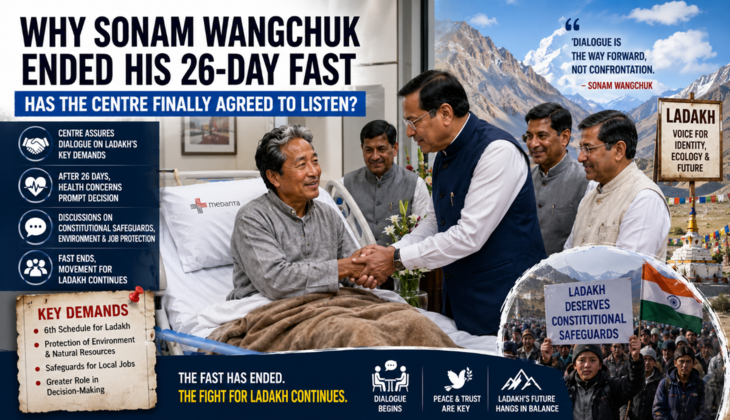
Environmentalist and education reformer Sonam Wangchuk ended his 26-day hunger strike at Medanta Hospital after receiving assurances from the Central Government. He broke his fast in the presence of Union Ministers, bringing temporary relief to thousands of supporters who had been worried about his declining health. But while the fast has ended, the larger questions surrounding Ladakh's future remain unanswered.
The end of the hunger strike is not the end of the movement. Instead, it marks the beginning of what could be a new phase of dialogue between the Centre and the people of Ladakh.
Why Was Sonam Wangchuk On Hunger Strike?
Sonam Wangchuk has been one of the strongest voices demanding greater constitutional safeguards for Ladakh. Since the region became a Union Territory in 2019 after the abrogation of Article 370, many local groups have argued that Ladakh has lost political representation and legal protections over its land, jobs, and natural resources.
Wangchuk's fast was aimed at drawing the Centre's attention to these concerns. His key demands included constitutional protection under the Sixth Schedule, safeguards for Ladakh's fragile environment, protection of local employment, and a greater role for local people in decision-making.
He repeatedly said that the movement was not against the government but in favour of preserving Ladakh's identity, ecology, and future.
Why Did He End The Fast?
The immediate reason behind ending the fast was the Centre's assurance that discussions on Ladakh's concerns would move forward. Union Ministers met Wangchuk at Medanta Hospital and appealed to him to end his hunger strike, promising continued engagement on the issues raised by him and various Ladakhi organisations.
His health had also become a matter of concern after nearly four weeks without food. Doctors monitoring his condition advised that continuing the fast could pose serious health risks.
By ending the fast, Wangchuk signalled that he was willing to give dialogue a chance. However, he also made it clear that ending the hunger strike should not be seen as the end of the movement.
What Has Been Achieved?
The biggest outcome so far is that Ladakh's demands have once again come to the national stage.
For weeks, the hunger strike attracted support from environmentalists, students, civil society groups, and several public figures across the country. It forced policymakers to acknowledge that many people in Ladakh continue to seek stronger constitutional safeguards.
The Centre's willingness to engage with Wangchuk has also reduced immediate tensions and created space for negotiations.
However, none of the major demands have yet been formally accepted. There has been no official announcement regarding Sixth Schedule status or other constitutional protections.
The Challenges Ahead
The road ahead will not be easy.
Granting constitutional safeguards involves legal, political, and administrative considerations. The Centre will have to balance national security interests, regional development, and the aspirations of the people of Ladakh.
At the same time, Ladakh's unique environment makes the issue even more important. Rapid infrastructure development, climate change, and increasing tourism have raised concerns about ecological damage in one of India's most sensitive mountain regions.
Many experts believe that any future development model must protect both the local economy and the fragile Himalayan ecosystem.
Dialogue Must Lead To Action
The success of the current breakthrough will depend on whether discussions translate into concrete decisions. If talks fail to produce meaningful progress, public dissatisfaction could return.
For many residents, this is not only about constitutional provisions but also about ensuring that future development does not come at the cost of Ladakh's culture, environment, and traditional way of life.
TVN Insight
Sonam Wangchuk's decision to end his 26-day fast is a positive step, but it is only the beginning of a much larger conversation. Hunger strikes often draw attention, but lasting solutions come through policy, trust, and sustained dialogue.
The Centre now has an opportunity to show that it is willing to listen to the concerns of Ladakh's people. Whether this moment becomes a turning point or just another pause in a long struggle will depend on what happens in the weeks and months ahead.
Top of Form
Bottom of Form