
Who Is Ashok Thombre? The Fake PMO Secretary Caught At A Sambhajinagar Wedding
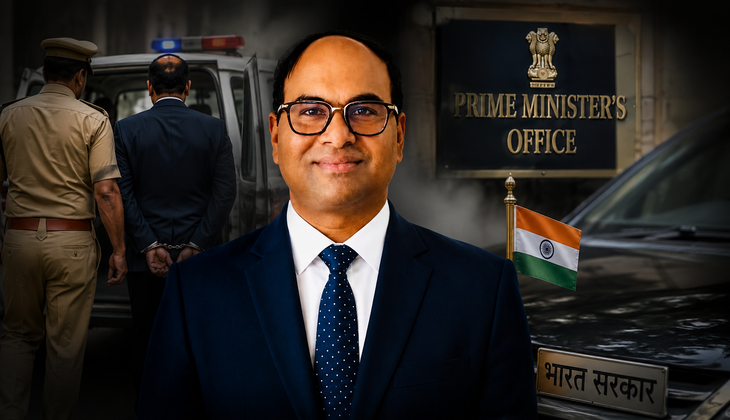
An alleged fake PMO Secretary was arrested at a wedding in Chhatrapati Sambhajinagar after police questioned his identity. The case highlights how impersonation, fake government credentials and staged public appearances can be used to build credibility and why simple verification is crucial.
The compere had a list. That is how it broke.
Every Indian wedding with politics in the guest list runs the same segment — the felicitation. Shawls, bouquets, names read out from a sheet, a queue of dignitaries taking turns on stage. This one was on the Solapur–Dhule highway, at a hotel in Chhatrapati Sambhajinagar. The bride was a BJP office-bearer's daughter. Chief Minister Devendra Fadnavis was expected. Police were already deployed.
Then the compere called a name and a designation: Ashok Thombre, Secretary, Prime Minister's Office, Delhi.
A man walked up. Within minutes he was in a police vehicle.
Who is Ashok Thombre?
Ashok Bharat Thombre, 45, is from Undri in Beed district and was living in Sadar Bazar, Delhi, at the time of his arrest on 16 November 2025. Police say he had been presenting himself as a Secretary in the Prime Minister's Office. According to the PTI report on the case, he also claimed to be a member of NITI Aayog.
He could not produce a single credential.
The second man arrested was Vikas Prakash Pandagale, 35, from Kondhwa Khurd in Pune, who was sitting in Thombre's car and describing himself as his bodyguard. A case was registered against both at MIDC Waluj police station.
What gave him away
Deputy Commissioner of Police (Zone 1) Pankaj Atulkar was standing in that hall when the name was announced. Something about the man's manner did not sit right with him, and he did what most people in that room would have found awkward — he went over and started asking questions.
Thombre stumbled on the answers.
Atulkar's team did not wait. They rang the Prime Minister's Office directly. No officer of that name worked there. There was also no record of any Central government Secretary making an official visit to the district that weekend.
Inside the car, police found a board that read *Bharat Sarkar*. Alongside it, a tricolour of the kind mounted on government vehicles.
The whole thing took less time than the felicitation ceremony.
The problem with claiming to be from the PMO
Here is what makes this particular lie a bad one, and it is worth spelling out for readers.
The PMO's senior officers are a short, published, entirely traceable list. A Principal Secretary. An Additional Principal Secretary. A handful of Secretaries, Joint Secretaries and Directors, every one of them a career civil servant with a service record you can look up. NITI Aayog's members are named on its own website — you could check the claim from your phone during the tea break.
Thombre allegedly claimed both.
People who actually hold offices like these tend to say less about them, not more, because the office already does the talking. Impersonators go the other way. The announcement is the entire asset. That gap between how a real officer behaves and how the fake one performs is usually visible well before anyone runs a check, and on 16 November it was visible to a DCP standing thirty feet away.
What the kit costs
Look at what police recovered and you get a sense of the economics.
A vehicle board saying *Bharat Sarkar*. Nobody at a hotel gate verifies a sign. There is no system to verify it against.
A tricolour on the bonnet. Most people assume this is loosely permitted. It is not. Under the Flag Code of India, flying the national flag on a car is restricted to a specific list — the President, the Vice-President, Governors, the Prime Minister, Union Cabinet Ministers, the Chief Justice, the Speaker, and a few others. The gap between what people think the rule is and what it actually is happens to be the exact space the prop works in.
A bodyguard. This is the piece that should collapse under the lightest pressure. Protected persons in India get security assigned by the state police or a central armed force after a threat assessment. It comes with uniformed or documented personnel. Nobody senior enough to need protection arranges it himself and drives up with a friend in the passenger seat.
Printed visiting cards, in some cases. In 2023, Kashmir Police went as far as arresting the printer in Ahmedabad who had produced fake cards for a Gujarat man posing as an Additional Director in the PMO.
Total outlay: a few thousand rupees. What it opens: a stage, and the people standing on it.
The photograph is the product
The common assumption about a case like this is that the man came to steal something. He did not. Nobody at a wedding hands cash to a stranger from Delhi.
He came for the stage.
Think about what a felicitation slot produces. A shawl. A bouquet. Photographs of him flanked by an MLA, a district officer, a party functionary, all of them real. Those pictures go on WhatsApp. They go to the contractor who wants a tender moved along, to the family that has been told a transfer can be arranged, to whoever is about to be asked for a "processing fee" for a job in Delhi. Sometimes to a prospective bride's family.
The wedding is not where the money changes hands. It is where the credibility is manufactured. The money comes later, in another district, from someone who saw a photograph.
Which makes the felicitation ceremony — that harmless fixture of every function in the country — the softest point in the whole event. It is the one moment when the organisers themselves stand up, announce a guest's claimed identity into a microphone, and certify it to a room full of witnesses, on the strength of whatever he wrote on a form.
How far these things run when nobody asks
Sambhajinagar ended in minutes. It is worth knowing what happens when it does not.
In March 2023, Kiran Patel of Gujarat was picked up from the Lalit Grand Palace hotel in Srinagar for posing as a senior PMO official. He had not merely attended a few events. He had secured genuine VVIP protocol and security cover from the Jammu and Kashmir administration, was on his third trip to the Valley, and had reportedly been recommended for security by a serving Deputy Commissioner. He claimed a government mandate to identify apple orchards in south Kashmir. Police found ten visiting cards in his possession, carrying different identities. Cheating FIRs followed in Gujarat.
Three visits. Real security cover. State hospitality.
The distance between that case and this one is one officer who was willing to ask a rude question.
This is a security story, not a funny one
It reads like a colourful item, and it will get shared as one. It should not be filed that way.
The Chief Minister of Maharashtra was expected at that venue. Security had been arranged accordingly. And an unverified man with a Government of India board and a tricolour on his car, accompanied by someone presenting himself as protection, had got as far as the stage inside that perimeter.
He was stopped by a policeman's judgment. Not by a check.
The question for anyone organising an event is not whether he was caught. It is what in the process was ever going to catch him.
The law on impersonating a government officer
Prosecutors usually stack several provisions in cases like this.
Under the Bharatiya Nyaya Sanhita, 2023: personating a public servant (Section 204), wearing the garb or carrying a token used by a public servant with fraudulent intent (Section 205), cheating by personation (Section 319), and cheating (Section 318) where money or property has actually moved. Forgery provisions apply if cards, letters or documents were fabricated.
Separately, the Emblems and Names (Prevention of Improper Use) Act, 1950 restricts use of the Government of India's name and emblem. The Flag Code of India, 2002, read with the Prevention of Insults to National Honour Act, 1971, covers misuse of the tricolour, including on vehicles.
Note one thing about this list: several of these offences do not need a victim who lost money. The impersonation is itself the crime. The law treats the harm as occurring at the point of access, not the point of payment — which, given what these photographs are worth later, is the right way round.
Four questions that close the gap
If you organise events where dignitaries are announced, this is the whole defence:
Is there a tour programme? A Central government officer travelling officially moves on a documented programme routed through the district administration. One call to the collector's office or the protocol officer settles it.
Who signed off on the felicitation list? Whoever writes the compere's script is certifying every designation read aloud. That needs one named person owning it, not a list assembled from forwarded WhatsApp messages.
Can he show a Government of India identity card? Not a visiting card. Not a letterhead. An ID.
Who arranged his security? If the answer is that he brought his own, the claim has already contradicted itself.
The uncomfortable bit
None of this required a good disguise. A printed board, a flag, and a friend willing to stand behind him looking serious.
What nearly made it work was manners.
In a room built around rank, asking a senior man to prove who he is registers as an insult — and the higher the rank he claims, the ruder the question gets. That is the actual vulnerability. Not gullibility. Deference, and the fact that nobody wants to be the person who asked.
On 16 November, at a wedding in Chhatrapati Sambhajinagar, one man was willing to be that person.
FAQ
Who is Ashok Thombre?
Ashok Bharat Thombre, 45, is a resident of Undri in Beed district who was living in Sadar Bazar, Delhi. He was arrested on 16 November 2025 for allegedly posing as a Secretary in the Prime Minister's Office at a wedding in Chhatrapati Sambhajinagar.
Why was Ashok Thombre arrested?
Police say he presented himself as a PMO Secretary — and, per PTI, also as a NITI Aayog member — but could produce no credentials. The PMO confirmed no officer of that name worked there.
Where was Ashok Thombre arrested?
At a hotel on the Solapur–Dhule highway in Chhatrapati Sambhajinagar, during a wedding that Chief Minister Devendra Fadnavis was expected to attend. The case was registered at MIDC Waluj police station.
Who caught Ashok Thombre?
Deputy Commissioner of Police (Zone 1) Pankaj Atulkar, who was present at the event and questioned him after his name was announced during the felicitation ceremony.
Who is Vikas Pandagale?
Vikas Prakash Pandagale, 35, of Kondhwa Khurd in Pune, was arrested alongside Thombre. He was in the car and described himself as Thombre's bodyguard.
What was found in Ashok Thombre's vehicle?
A board reading *Bharat Sarkar* and a tricolour of the type used on government vehicles.
Is impersonating a government officer a crime in India?
Yes. Personating a public servant is an offence under Section 204 of the Bharatiya Nyaya Sanhita, with related provisions covering fraudulent use of official garb or tokens, cheating by personation, and misuse of the national flag and government emblems.