
Pakistan Claims 88 Militants Killed in Fresh Balochistan Crackdown. India Once Again Drawn Into the Narrative
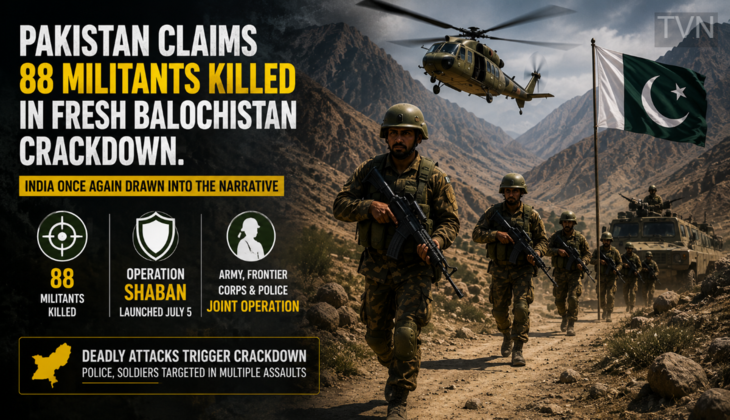
Pakistan has claimed that its security forces have killed 88 suspected militants in a large-scale counterterrorism operation across Balochistan following a series of deadly attacks on police and security personnel. The military campaign, known as Operation Shaban, began on July 5 and is being carried out jointly by the Pakistan Army, Frontier Corps and Balochistan Police.
According to Pakistani authorities, the latest phase of the operation resulted in the deaths of nine more suspected militants, taking the total number killed since the operation began to 88. Officials say the offensive will continue until militant networks operating in the province are dismantled.
What Triggered the Operation?
The crackdown was launched after one of the deadliest waves of violence in Balochistan in recent months.
Armed militants attacked a police post near the Mangi Dam area in Ziarat district, killing several police personnel and abducting others. Authorities later recovered the bodies of 18 kidnapped police officers. Separate attacks also claimed the lives of soldiers, taking the overall death toll among security personnel to more than 40.
Pakistan has blamed much of the violence on the banned Baloch Liberation Army (BLA), a separatist militant group that has claimed responsibility for several recent attacks in the province.
What Is Operation Shaban?
Operation Shaban is a coordinated military campaign involving the Pakistan Army, Frontier Corps and provincial police. It includes intelligence-based raids, ground operations and aerial strikes targeting suspected militant hideouts in the mountainous regions of Balochistan.
Pakistani officials say the objective is to dismantle militant networks and prevent further attacks on security forces, government installations and infrastructure projects.
Why Is Balochistan So Important?
Balochistan is Pakistan's largest province and is rich in natural resources, including natural gas, copper and gold. It is also home to Gwadar Port, a key component of the China-Pakistan Economic Corridor (CPEC), one of China's biggest overseas infrastructure investments.
Despite its strategic importance, the province has witnessed a decades-long insurgency. Separatist groups argue that Balochistan's natural resources are being exploited while local communities remain economically and politically marginalised. Many of these groups demand greater autonomy, while some seek complete independence from Pakistan.
Islamabad rejects these claims and considers groups such as the Baloch Liberation Army to be terrorist organisations responsible for attacks on civilians, security personnel and Chinese interests.
India Once Again Enters the Debate
As it has done on several occasions in the past, Pakistan has once again accused India of supporting and financing militant groups operating in Balochistan. Pakistani officials have frequently alleged that external support enables separatist organisations to target security forces and disrupt projects linked to the China-Pakistan Economic Corridor.
India has consistently rejected these accusations, calling them baseless and politically motivated. New Delhi maintains that Pakistan uses such allegations to divert attention from its own internal security challenges and the long-running insurgency in Balochistan.
The accusations are not new. Ever since the insurgency intensified, Pakistan has repeatedly blamed India for backing Baloch separatist groups. However, India has denied any involvement, and Pakistan has not publicly presented evidence that has been widely accepted internationally to establish direct Indian involvement in funding or directing the insurgency.
The issue has remained a recurring point of tension in India-Pakistan relations, with both countries accusing each other of interfering in internal affairs.
What Happens Next?
Pakistan says Operation Shaban will continue until militant groups are neutralised and security is restored across Balochistan. Security agencies remain on high alert as intelligence-based operations continue in several districts.
For Pakistan, the operation is part of a broader effort to curb separatist violence and protect strategic projects such as CPEC. For India, the renewed allegations are likely to be viewed as another attempt by Islamabad to link New Delhi to Pakistan's internal security problems.
As violence continues in Balochistan, the province is expected to remain one of South Asia's most sensitive flashpoints, with implications not only for Pakistan's internal security but also for regional geopolitics and India-Pakistan relations.