
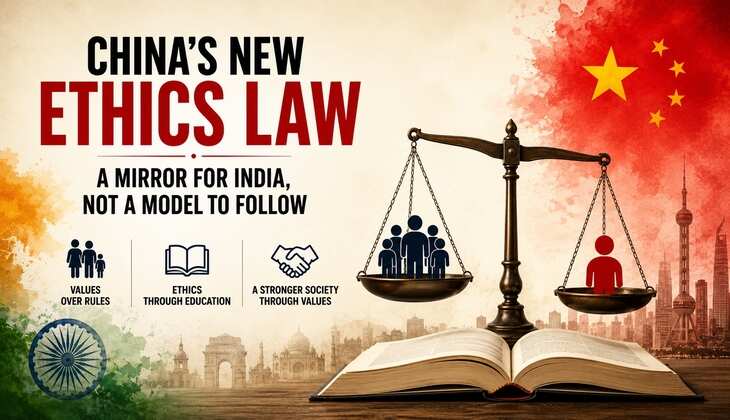
China's New Ethics Law: A Mirror for India, Not a Model to Follow
Can a government teach people how to be good citizens through a law?
China believes it can.
The country has introduced its first comprehensive Ethics Promotion Law, a legislation that seeks to promote values such as honesty, patriotism, respect for elders, social responsibility and civic discipline. These principles will now be encouraged across schools, workplaces, businesses, media organisations and digital platforms.
At first glance, there is nothing unusual about these ideals. Every society wants responsible citizens. Every nation values integrity and accountability.
The real debate, however, is not about the values themselves. It is about who gets to shape them.
That is why China's new law deserves India's attention.
A Law That Goes Beyond Crime
Most laws tell people what they cannot do.
China's new legislation tries to influence what people should do. Instead of limiting itself to preventing crime, it encourages citizens to follow a common moral framework that aligns with the country's political vision.
The state is no longer just making rules. It is also trying to shape everyday behaviour.
This approach reflects China's belief that a nation's strength comes not only from economic growth or military power but also from a shared sense of identity and discipline.
Why Now?
The timing is significant.
China is dealing with slower economic growth, an ageing population, changing family structures and the social impact of rapid technological change. Young people are growing up in a world that looks very different from the one their parents knew.
Like many countries, China is asking itself an important question. What keeps a society united when economic progress alone is no longer enough?
Its answer is to reinforce a common set of values through law and public institutions.
Whether legislation can actually shape character is another matter.
India's Story Is Different
India has never relied on uniformity to stay together.
Its strength comes from diversity. Different languages, faiths, customs and cultures have existed side by side for generations. The Constitution provides a common foundation, while society remains free to express its many identities.
That diversity often creates disagreements, but it also keeps democracy alive.
For this reason, a state driven ethics law on the Chinese model would not fit India's constitutional philosophy or its social fabric.
The Real Challenge Before India
Even so, India should not dismiss the larger issue.
Many of the country's everyday problems have less to do with weak laws and more to do with weak civic responsibility. Corruption, reckless driving, misinformation, digital fraud and poor civic behaviour cannot be solved through punishment alone.
They require something deeper.
A society becomes stronger when people choose to do the right thing even when nobody is watching.
That is where ethics matter.
The Digital Age Has Changed the Conversation
Artificial intelligence, deepfakes, online scams and misinformation have made ethical judgement more important than ever.
Technology is advancing faster than regulations can keep up. As a result, many of today's challenges are not just legal questions but moral ones.
Countries around the world are searching for ways to build responsible digital citizens.
China has chosen legislation.
Most democracies are choosing education, public awareness and stronger institutions.
What Should India Take Away?
India does not need a law that tells people how to think or what values to follow.
What it needs is a stronger culture of civic responsibility.
Schools must give greater importance to civic education. Digital literacy should become a basic life skill. Businesses should place ethics at the centre of governance rather than treating it as a compliance exercise. Public institutions must earn trust by practising the values they expect citizens to uphold.
Ethics cannot simply be written into a law book.
They grow through education, leadership, accountability and everyday choices.
China's new Ethics Promotion Law reflects one way of building a nation, where the state takes the lead in shaping society.
India has always believed in another path, one where values grow through families, communities, democratic institutions and constitutional principles.
That difference is worth preserving.
It is also the biggest lesson India can take from China's latest experiment.
TVN Insight
China's new Ethics Promotion Law offers India an important lesson, but not a model to replicate. The emphasis on civic responsibility, honesty, and ethical behaviour is relevant for a country facing challenges such as corruption, digital fraud, misinformation, and declining civic discipline. However, India's strength lies in its democratic values, constitutional freedoms, and cultural diversity. A state-driven law that defines morality would be at odds with these principles. Instead of legislating ethics, India should focus on strengthening civic education, promoting digital literacy, encouraging ethical governance, and building institutions that earn public trust. The real takeaway is that while ethics are essential for nation-building, they are most effective when they grow through education, leadership, and social responsibility rather than government enforcement.