
The Economics of War: Why Wars Often Become Profitable for Some
War is often described as humanity’s greatest tragedy. It destroys lives, collapses economies, displaces populations, and leaves behind damage that lasts for decades. Yet history shows a complex truth—while nations and people suffer, certain industries and actors often experience massive financial gains.
This contradiction is why economists describe war as one of the world’s biggest economic paradoxes: devastating for society, but profitable for selected sectors.
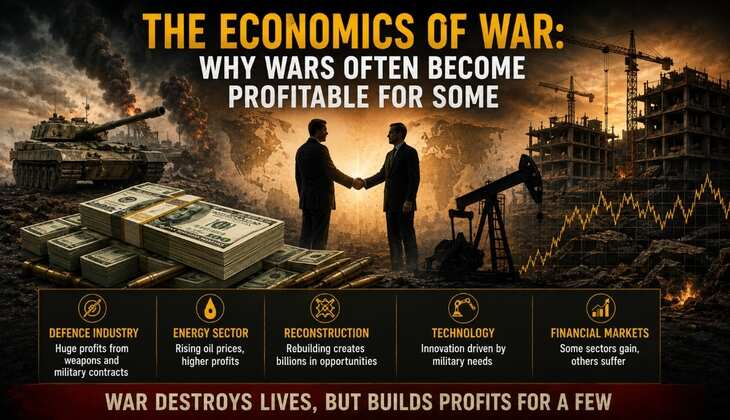
Defence Industry: The Biggest Winner
The most direct beneficiaries of war are defence and military companies. Whenever global tensions rise, governments dramatically increase defence spending.
This leads to massive contracts for fighter jets, missiles, drones, tanks, surveillance systems, radar equipment, and cybersecurity tools.
Major global defence companies such as Lockheed Martin, Raytheon Technologies, BAE Systems, and Northrop Grumman often see their revenues rise during prolonged conflicts or geopolitical instability.
Even countries not directly involved in war increase military budgets out of security concerns, creating a global ripple effect of defence spending.
Energy Sector Gains from Price Shocks
Oil and gas markets are deeply tied to global conflicts. Wars in or near energy-producing regions often disrupt supply routes, causing crude oil and natural gas prices to rise sharply.
This price surge benefits major energy exporters and multinational oil companies such as ExxonMobil and Shell, while importing countries face inflation and economic pressure.
Energy markets remain one of the fastest channels through which war impacts the global economy.
Financial Markets: Winners and Losers
War creates uncertainty, and financial markets react instantly.
While stock markets may fall initially, certain sectors tend to gain:
- Defence and weapons manufacturers
- Cybersecurity firms
- Energy companies
- Gold and commodity markets
At the same time, industries like aviation, tourism, shipping, and global trade often suffer due to instability and reduced travel.
During such times, investors also move towards safe assets like gold and US government bonds, reinforcing their role as financial “safe havens.”
Who Actually Benefits from War?
Beyond industries, several groups and sectors indirectly benefit from war conditions:
1. Defence Contractors
Companies supplying weapons, ammunition, surveillance systems, and military technology see long-term demand spikes.
2. Energy Corporations
Oil and gas exporters benefit from rising global prices caused by supply disruptions.
3. Technology & Cybersecurity Firms
Modern warfare increasingly depends on digital systems, boosting companies involved in surveillance, encryption, and cyber defence.
4. Logistics and Transport Companies
Military supply chains and emergency logistics create sudden demand for transport infrastructure and services.
5. Reconstruction and Infrastructure Firms
After conflicts end, rebuilding creates a second wave of profit opportunities for construction, cement, steel, and engineering companies.
Reconstruction: The Second Economy of War
Once conflict ends, destruction turns into business opportunity.
Cities, bridges, roads, hospitals, and power systems must be rebuilt. This creates massive contracts for infrastructure firms and international aid-backed development projects.
However, this “reconstruction economy” exists only because of earlier destruction, highlighting the paradox of war-driven growth.
Governments Spend More, Citizens Pay More
War financing usually comes through borrowing, increased taxes, and reallocation of national budgets.
This leads to long-term economic pressure, including:
- Rising inflation
- Higher public debt
- Reduced spending on healthcare and education
- Currency instability in weaker economies
Ultimately, ordinary citizens bear most of the financial burden through higher prices and reduced services.
Technology Advances Under Pressure
Many modern technologies have roots in military development.
Advances in aviation, radar, satellites, GPS, nuclear energy, and artificial intelligence have all been accelerated by defence needs.
While these innovations later benefit civilian life, their initial development is often driven by wartime urgency and government defence funding.
Who Really Profits?
Although war generates profits in certain sectors, it is important to understand that these gains are highly concentrated.
Companies in defence, energy, cybersecurity, and reconstruction may grow financially, but societies at large face economic decline, human suffering, and long-term instability.
The wealth created during war does not offset the loss of lives, infrastructure, and social progress.
The Real Cost of Conflict
Even if war appears “profitable” for some industries, it remains one of the most expensive human events in history.
The true cost is not measured only in money but in broken societies, lost generations, and destroyed futures.
History consistently shows that long-term prosperity is built not through conflict, but through peace, trade, stability, and cooperation between nations.