
Europe Tightens Grip on Google: What the EU's $1 Billion Antitrust Fine Means for Big Tech
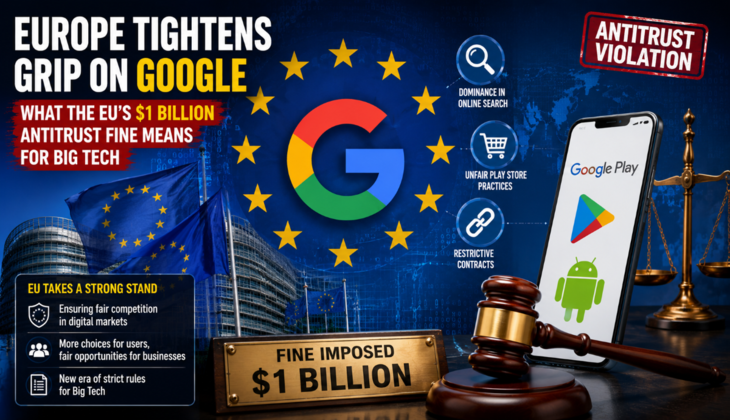
The European Union has once again taken a strong stand against Google, imposing a fresh antitrust fine of nearly $1 billion over what regulators say are anti-competitive practices linked to Android, the Google Play Store, and its dominance in online search. The move is part of Europe's continuing effort to ensure that large technology companies do not misuse their market power to limit competition.
While Google has repeatedly denied wrongdoing and defended its business practices, the latest action sends a clear message that the European Union is determined to make Big Tech follow stricter rules.
Why Has Google Been Fined?
According to European regulators, Google has used its dominant position in the digital ecosystem to give its own services an unfair advantage over competitors.
The investigation focused on how Google's Play Store policies and search services affect app developers and consumers. Regulators believe that certain practices make it difficult for rival companies to compete fairly and reduce the choices available to users.
The European Commission argues that companies with such a large market share have a greater responsibility to ensure fair competition instead of using their position to strengthen their dominance.
Google has maintained that its products benefit consumers by providing secure services, improving innovation, and supporting millions of developers across the world.
Europe's Tough Stand on Big Tech
This is not the first time the European Union has acted against Google. Over the past decade, Brussels has imposed several major penalties on the company over issues involving shopping services, Android licensing, digital advertising, and search practices.
The EU has also introduced new laws such as the Digital Markets Act (DMA) and the Digital Services Act (DSA). These laws are designed to prevent technology companies from abusing their market position, increase transparency, and create a more level playing field for smaller businesses.
Instead of waiting for problems to arise, Europe now wants to regulate digital platforms before they become too powerful.
Why Does This Matter Beyond Europe?
Although the fine has been imposed by the European Union, its impact extends far beyond Europe.
Google operates in almost every country, and changes it makes to comply with European regulations often affect users worldwide. App developers, smartphone manufacturers, and digital businesses may all see changes in how Google's ecosystem operates.
Other governments are also closely watching Europe's approach. Countries such as the United States, India, Australia, Japan, and South Korea have increased scrutiny of large technology firms over concerns related to competition, user privacy, and market dominance.
The EU's actions are therefore shaping the global conversation on how digital markets should be regulated.
What Could Change for Users?
For ordinary users, the immediate impact may not be obvious. However, stronger competition could eventually lead to more choices in app stores, search services, digital payments, and other online platforms.
Developers may also gain greater freedom in how they distribute apps or process payments, reducing their dependence on a single platform.
At the same time, technology companies argue that excessive regulation could slow innovation, increase compliance costs, and make it harder to introduce new products quickly.
Finding the right balance between regulation and innovation remains one of the biggest challenges for policymakers.
A Global Battle Over Digital Power
The latest penalty reflects a broader shift in how governments view the technology industry. For years, companies like Google, Apple, Meta, Amazon, and Microsoft expanded rapidly with relatively limited regulation.
Today, that environment has changed. Regulators are increasingly questioning whether a handful of companies have gained too much control over digital markets.
The debate is no longer just about one company or one fine. It is about who controls the digital economy and how governments can ensure that innovation benefits consumers without harming competition.
TVN Insight
The European Union's latest action against Google is about more than a billion-dollar fine. It represents a growing belief that digital markets need stronger oversight as technology becomes central to everyday life.
For Big Tech, the message is clear: market leadership comes with greater responsibility. For governments around the world, Europe has once again set the benchmark for regulating powerful digital platforms. The real challenge now is ensuring that competition is protected without slowing the innovation that drives the global technology industry.