
Russia's Massive Strike on Ukraine Signals a New Phase of the War
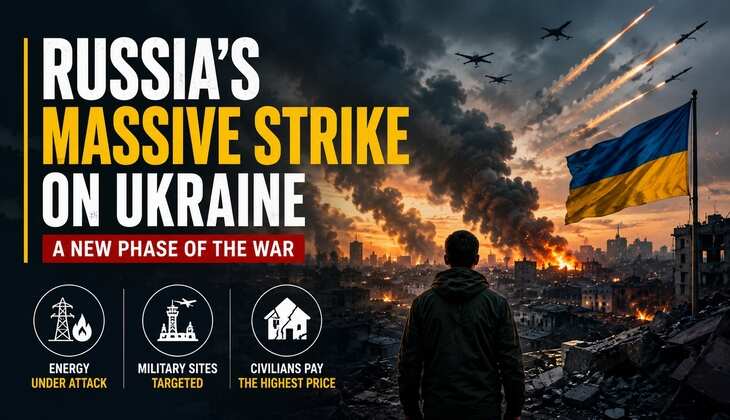
Energy and Military Infrastructure Under Attack
Russia launched one of its largest combined missile and drone attacks on Ukraine, targeting energy infrastructure, military airfields and defence-industrial facilities across multiple regions. The Kremlin described the assault as a retaliatory operation aimed at weakening Ukraine's military capabilities, while Ukrainian authorities said the strikes also caused significant damage to civilian areas, disrupting electricity supplies and destroying residential buildings.
The large-scale attack reflects Moscow's continued strategy of targeting infrastructure that supports both Ukraine's military operations and its civilian economy.
Why Energy Infrastructure Matters
In modern warfare, electricity has become as important as ammunition. Power plants, substations and fuel depots keep hospitals functioning, trains moving, communication networks active and military equipment operational.
By striking these facilities, Russia is attempting to reduce Ukraine's ability to sustain its war effort while increasing pressure on the country's economy and everyday life. Even temporary power disruptions can slow industrial production, interrupt transportation and complicate military logistics.
Military Sites Become Strategic Targets
Alongside energy facilities, Russia also targeted defence manufacturing units and military airfields that play a crucial role in producing and maintaining weapons, drones and missile systems.
Disrupting these facilities could affect Ukraine's ability to repair damaged equipment, manufacture military supplies and support operations along the front lines. As the war evolves, both countries are increasingly focusing on destroying strategic assets instead of relying solely on direct battlefield engagements.
The Human Cost Behind Every Strike
While military infrastructure remains the stated target, civilians continue to bear the greatest burden. Air raid sirens, damaged homes, power outages and disrupted daily life have become a harsh reality for millions of Ukrainians.
For many families, every night now carries uncertainty. Children seek shelter underground, emergency workers search through collapsed buildings, and communities are left rebuilding after each wave of attacks. The humanitarian impact continues to grow even as military objectives dominate the headlines.
A Conflict That Is Constantly Evolving
The latest strikes underline how the Russia-Ukraine war has transformed into a battle of endurance. Rather than focusing only on capturing territory, both sides are increasingly targeting critical infrastructure to weaken each other's ability to continue fighting.
As Ukraine continues its own long-range drone operations inside Russian territory and Russia intensifies its aerial campaign, the conflict shows few signs of slowing down. With diplomacy remaining stalled, military escalation continues to define the course of the war.
The Bigger Picture
Russia's latest assault is more than another round of missile strikes. It highlights how modern conflicts are fought not only on battlefields but also through attacks on power grids, factories and supply networks that keep a nation functioning.
As both sides continue to escalate, the war is becoming less about individual battles and more about who can sustain the longer fight. Unfortunately, it is ordinary civilians who continue to pay the highest price, living through repeated disruptions, uncertainty and the constant threat of violence.
A Window Created by Global Distractions
The timing of Russia's latest offensive is unlikely to be a coincidence. With the United States preoccupied by tensions with Iran and grappling with domestic political challenges, Moscow may have sensed an opportunity to intensify military operations while Washington's strategic focus is divided. Whether this changes the broader course of the war remains uncertain, but it highlights how major powers often exploit moments when their rivals are managing multiple crises at once. In geopolitics, timing can be as important as military strength.