
Why the US Dollar Is Considered the Currency for All Seasons
The Currency That Rules the Global Economy
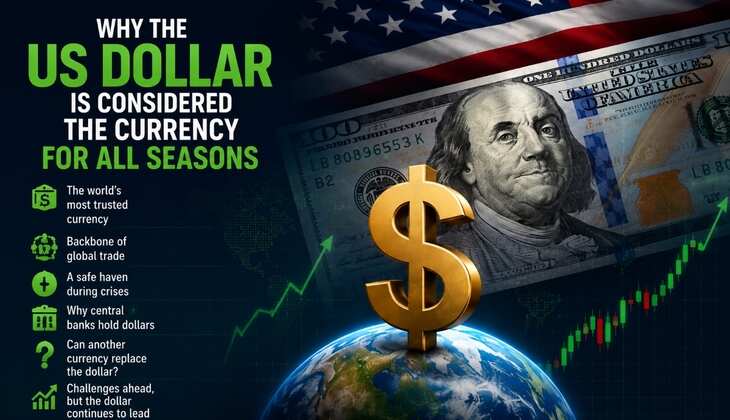
From wars and financial crises to pandemics and economic booms, one currency has consistently remained at the center of the global financial system—the US Dollar (USD). Often called the world's "currency for all seasons," the dollar has become much more than America's national currency. It is the preferred medium for global trade, the largest reserve currency held by central banks, and the safest destination for investors during times of uncertainty.
The dollar's dominance is not based solely on the strength of the American economy. It is supported by decades of trust, stable institutions, deep financial markets, and its unmatched role in international commerce. Despite repeated attempts to challenge its position, no other currency has managed to replace it.
How the Dollar Became the World's Currency
The dollar's journey to global dominance began after the Second World War. In 1944, the Bretton Woods Agreement established the US dollar as the anchor of the international monetary system. Many global currencies were linked to the dollar, while the dollar itself was backed by gold.
Although the United States ended the direct convertibility of dollars into gold in 1971, the currency retained its dominant position. By then, global trade, banking systems, and financial institutions had already built their operations around the dollar, creating a network that became increasingly difficult to replace.
The Backbone of Global Trade
Today, most internationally traded commodities—including crude oil, natural gas, gold, copper, and agricultural products—are bought and sold in US dollars. This system, often referred to as the "petrodollar" system in the case of oil, means that countries around the world need a steady supply of dollars to pay for essential imports.
Whether a country is importing oil from the Middle East, buying aircraft from the United States, or conducting international business with another nation, there is a high probability that the transaction will be settled in dollars. This constant global demand helps maintain the currency's dominance.
Why the World Runs Towards the Dollar During Crises
Whenever global uncertainty rises, investors almost instinctively move their money into dollar-denominated assets. During the 2008 global financial crisis, the COVID-19 pandemic, the Russia-Ukraine conflict, and recent geopolitical tensions in the Middle East, demand for the dollar increased despite the crises affecting the global economy.
The reason is simple. Investors trust the United States Treasury market more than any other financial market. US government bonds are considered among the safest investments in the world, making the dollar a financial haven whenever markets become volatile.
Why Central Banks Continue to Hold Dollars
Central banks maintain foreign exchange reserves to protect their economies from financial shocks. More than any other currency, they continue to hold US dollars because of their liquidity, stability, and universal acceptance.
Dollar reserves allow countries to pay for imports, stabilize their own currencies, service international debt, and respond quickly during economic emergencies. Even countries seeking to reduce dependence on the dollar continue to maintain significant dollar reserves because there is currently no equally reliable alternative.
The Challengers That Tried to Break Dollar Dominance
Over the decades, several currencies and leaders have attempted to reduce the world's dependence on the dollar.
During the 1980s, Japan's booming economy led many analysts to believe that the Japanese yen could become a serious competitor. Japan had become a technological powerhouse and one of the world's largest exporters. However, after the collapse of Japan's asset bubble in the early 1990s, economic stagnation prevented the yen from emerging as a true global reserve currency.
The biggest institutional challenge came from the euro. Introduced in 1999, the common European currency rapidly became the world's second-largest reserve currency. Backed by one of the largest economic blocs on the planet, many economists believed the euro could eventually rival—or even replace—the dollar.
For a few years, that possibility appeared realistic. Several countries diversified part of their foreign exchange reserves into euros, and the currency became increasingly popular in international trade. However, the European sovereign debt crisis between 2009 and 2012 severely damaged investor confidence. Financial troubles in Greece, Ireland, Portugal, Spain, and Italy exposed structural weaknesses within the Eurozone, causing investors to once again seek the safety of the US dollar.
Another frequently discussed attempt came from Libyan leader Muammar Gaddafi, who proposed a gold-backed African currency—often referred to as the "gold dinar." His vision was for African nations to trade oil and natural resources using a common currency backed by gold instead of relying on the dollar or the euro. Although the proposal generated political interest, it was never implemented and disappeared following Libya's civil war in 2011.
More recently, countries within the BRICS grouping have promoted greater use of local currencies in international trade. China has expanded the international use of the yuan, while India, Russia, Brazil, and others have signed agreements to settle some bilateral trade in their own currencies. These initiatives have reduced dollar dependence in specific transactions, but they have not significantly changed the dollar's dominant role in global finance.
Why the Dollar Still Wins
Many currencies have strengths, but none possess the complete package required to replace the dollar.
The United States has the world's deepest financial markets, the largest government bond market, strong legal institutions, and unmatched liquidity. Investors know they can buy or sell trillions of dollars' worth of assets quickly and with confidence. That level of trust cannot be built overnight.
There is also a powerful network effect. Because most countries already trade in dollars, businesses naturally continue using dollars. Banks lend in dollars, commodities are priced in dollars, and international contracts are often written in dollars. The more people use the currency, the stronger its position becomes.
Challenges on the Horizon
Although the dollar remains dominant, it is not invincible. Rising US government debt, increasing geopolitical competition, and growing efforts toward de-dollarization have sparked discussions about a more multipolar financial system.
China continues promoting the yuan, central banks are increasing their gold reserves, and regional trade agreements are encouraging settlements in local currencies. Advances in digital currencies and central bank digital currencies (CBDCs) may also reshape international payments in the coming decades.
However, replacing the world's reserve currency requires far more than economic size. It demands global confidence, transparent institutions, political stability, deep capital markets, and decades of credibility—qualities that no alternative currently offers at the same scale.
The Currency for All Seasons
The US dollar has survived financial crises, recessions, geopolitical conflicts, technological revolutions, and repeated attempts to replace it. While challengers have emerged—from the Japanese yen and the euro to China's yuan and BRICS-led initiatives—the dollar continues to dominate global trade, investment, and foreign exchange reserves.
Its greatest strength is not simply America's economic power but the trust the world places in its financial system. Until another currency can match that combination of stability, liquidity, and international acceptance, the US dollar is likely to remain the world's "currency for all seasons" for many years to come.